

“A lot of military men with that heroic sort of experience want to brag”: Linden MacIntyre on the challenges of investigating the notorious, secretive Hugh Tudor
September 2025
Congratulations on releasing An Accidental Villain. The last time we talked, you had just published The Winter Wives, and you said you were going to London (UK) to do some research on a new project, and you weren’t sure how it was going to pan out. Was that for this book?
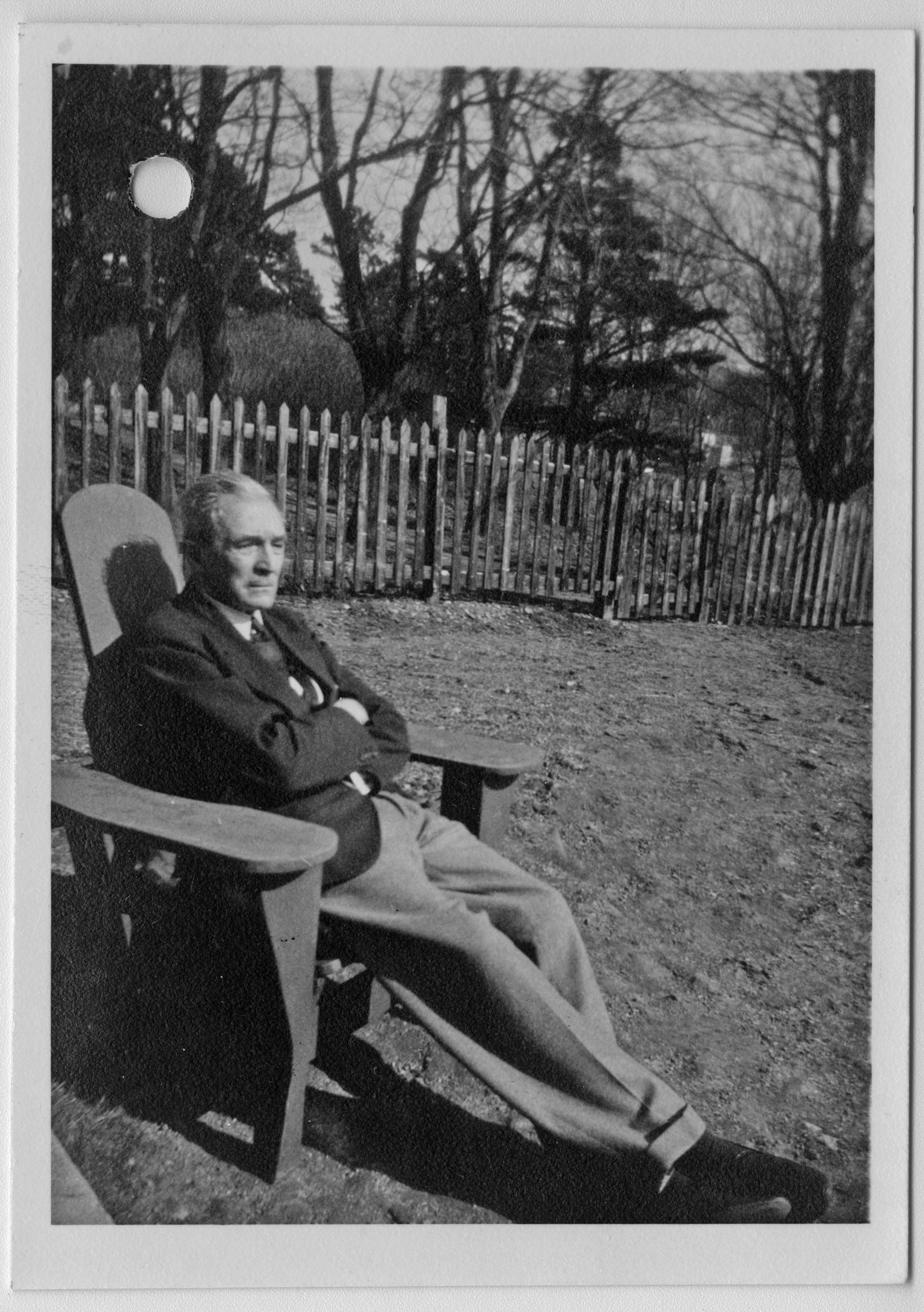
Yes. And then I think I did I say to you, as I said to a few other people, that there would never be another book after this one because it was so daunting. I know that’s how I felt. And I was only getting a sense then how difficult it was going to be to find anything out about this individual [Major General Sir Hugh Tudor], because he spent most of his life trying to be mysterious. He was, I mean, a lot of military men with that heroic sort of experience want to brag and like to write memoirs and like to write their own place in history, or if they have sins on their soul, if they had to write sort of self-serving accounts of what the problems were so that they don’t look as bad as they might look if somebody else had control. He was not like that at all. He kept a really dry, almost unreadable, diary during the First World War, full of details that are interesting I suppose to an academic, or in my case, I was able to find enough stuff in it that gave me an insight into who he was and what his life was like. He wrote no memoirs. He never made a speech about Ireland. He made the odd couple of speeches to small groups about the role of the Royal Newfoundland Regiment and the First World War, his experience with fighting Newfoundlanders. Tere was one to a Boy Scout troop, one to a service club. There was a testimonial dinner for Tommy Ricketts, and he proposed the toast. Those are the only occasions that I could find. He gave one newspaper interview to a reporter on his 92nd birthday. And the curious thing is that Ireland was not in the story.
Now, whether the reporter got the interview on the understanding that she would not mention Ireland, or maybe she didn’t even know about Ireland, but anyway, the story was written with no reference to Ireland at all. India, the First World War, how great he was and how brilliant is he was as a military man; not a word about Ireland, which I found odd. So that’s the way he set things up in his life. So to find out anything about him, I mean, St John’s Newfoundland had a ton of newspapers at various times. And they’re accessible on the Internet, if you know how to go looking. And there’s a a historian in St John’s called Mel Baker. He was a great help, because he haunts the archives. Mel Baker was a great guide through all the archival newspaper stuff, and I found little things like Tudor’s grandson, nobody even knew he had a grandson, but I found that grandson in an obscure reference to a gossip column in one of the St John’s papers. So it was going through all that stuff, and it was sort of reading histories of the Irish or Irish politics, and every so often coming up with a tiny detail that was usually very negative about Tudor. And I sort of jammed it all together and hopefully I came up with a portrait that’s useful to somebody.
It sounds like you had to do a deep dive and a very wide dive into these materials. What were you looking for when you went to London?
I thought through online sources, I could get into a collection of papers by General Tudor or whatever related the Irish, you know, the Chief of Police of Ireland and all that stuff. But I couldn’t. So I had to go to the Parliamentary Archives in London and the Kew Gardens Archives and plough through papers from the files of [UK Prime Minister] Lloyd George, Churchill, [Viscount] Hamar Greenwood, who was the last Chief Secretary for Ireland, a whole lot of memoirs and books that were written by people who were there along at the same time he was. There was one very active diary keeper in Dublin Castle while he was there, guy by the name of Mark Sturgis, [a British civil servant] who wrote well, and clearly, and he had a lot of references in his material to Tutor. But, you know, it was just like a line here, and a line there, a reaction to this, a reaction to that. But if you sort of put it all together, it does present a portrait that I think stands up to any kind of examination.
And how did you first hear that this figure, with such a brutal reputation in Northern Ireland, had ended up in Newfoundland?
I was reading an academic paper by Peter Neary and Mel Baker; they studied a lot of the [Sir Humphrey] Walwyn regime in Newfoundland [as Walwyn’s term as Governor spanned WWII]. And they were doing something on his papers, on a particular paper that Walwyn wrote about the conference between Churchill and Roosevelt in Placentia Bay in 1941. So they were going through Walwyn’s papers to understand what was going at that conference, and there was a passing reference to Churchill’s friend Major General Tudor, who lived in St John’s. “And Churchill wanted him to come over to Placentia Bay while he was there for a meeting and lunch.” And I said, “Well, that was some friendship!” And I got my appetite up, Why was he in St John’s now? if he was an old colleague of Churchill’s from in India and the various wars, what was he doing in St John’s? And then the stories started to unfold. He had been the commander of the battalion of Newfoundlanders in the First World War. He served in the War in the same infantry division at the same time in 1916 with Churchill, when Churchill sort of took a leave from politics. And Churchill continued to communicate with Tudor when he was back in politics as Minister of Munitions, Minister of War, and when Churchill sent him out to Palestine, after Ireland, some of the letters that he wrote were full of detail about what he was doing out there, and how frustrated he was, or how grateful he was for the opportunity, they were just constantly writing letters back and forth to each other. Now, these weren’t the kind of letters that spelled a lot of stuff out So again, it’s just, as you say, a deep dive into a lot of different pools: the newspaper archives from St John’s from that period of time, the archival files from the administration of Lloyd George, which paid specific attention to certain cabinet ministers, and you know, I just got to the point where I would sniff something relevant, just in the air and I would usually come up with something, but it was a matter of putting together an awful lot of small things. to get a larger picture.
So is there a kind of mystery behind his presence in St John’s?
No, there’s no mystery as to why he was there: he was there because it was a safe place. He was there because he had a friend, and I found this, he had a friend in London, who was a very famous ex-Navy officer who had a place a place called Harry’s Brook, St George’s District. Long story behind all that, but he was building a house there, this guy, his name was Campbell, Victor Campbell.
He was building a house over there, and he wanted to establish a little kind of commune of people like himself, you know, Interesting old soldiers and sailors and adventurers. And he persuaded Tudor.
They were going to the same military veterans club in London, and he persuaded Tudor that would be a good place for him, a safe place, a nice place, good people, colleagues, that he could talk to, and Tudor was kind of lured into it, various contacts in the fishery, in the salt fishery, and the exporting business, in Newfoundland, and London, persuaded him that they would set him up with a job, and he wouldn’t have to do a lot, he didn’t know anything about fish or business, but they would make it easy for him. There was Templeman, whose first name just escaped my mind [Phillip}, but he had a big fish company in St John’s, and then there was Percy Holmwood, in London, and they did a lot of business back and forth, and between the two of them, they were going to give him work to do in St John’s. And he wasn’t in St John more than a couple of months when, coincidentally, both Templetman and Holmwood died, just weeks apart. And so here he is over in St John’s, Newfoundland, supposedly with a job in al fish exporting business, and he didn’t know anything about fish or exporting or anything.
Check back next week for part 2 of our chat with Linden Macintyre. An Accidental Villain: A Soldier’s Tale of War, Deceit and Exile is published by Penguin Random House Canada.
This interview has been lightly edited for length and clarity.