

“Tudor decided ‘that myth is good for me because it’s a signal to anybody who might have something like that in mind: You’re not going to get away with it'”: Linden MacIntyre on An Accidental Villain, Part 2
September 2025
So, Tudor is in St John’s, and set up with a job in fish exports, but his original sponsors have unexpectedly died. What happened next?
Several businessmen who had connections to the Newfoundland Regiment, who admired Tudor’s military background, they helped him out. They kept him going. So he lasted in that position for seven or eight years, and then he kind of retired from that. But he still didn’t feel that it was safe to go to back to England, or anywhere, so he just stayed in Newfoundland. He connected with a woman, a very interesting woman, nobody quite knows how, those were the days when you could have privacy, a woman named Monica McCarthy, who was a nurse. And so she treated him during one of his illnesses, in middle age or late middle age; she was a lot younger than he was, but she stuck with him. And she eventually lived with him for many years, in several different places where he resided and was one of, I suppose, the next of kin when he died, because his family in England had nothing to do with him anymore. So Monica lived with him, and there was another woman, Monica’s friend, Carla Emerson, who is now Carla Emerson Furlong.
Oh, I just interviewed her for our winter issue. (The celebrated musician and teacher is now 103.)
She was a very close friend of Tudor. Her father [Frederick Emerson] had been one of his lawyers, her uncle, Edward Emerson, had been another. So Tudor was in and out of her life all the while he was in St John’s, and at the end of it, she would have been the last person alive when he died in 1965, who could say that she was his closest family, even though she wasn’t, but she had actually gone to England, she got to know some of his family over there. So when he died, Carla, and Monica, but mostly Carla, arranged the funeral, and what was done afterwards. And, you know, she connected to the family, and took care of his final estate and stuff like that. So she was a great find. I visited her a number of times, talked on the phone, and she was so close to him that she was cagey in what she would say.. It took a lot of conversations to get her to say something that was kind of meaty. And she came up with a few things. The last time I went to see her was about a year ago, I think. just about a year ago. And I knocked on the door and I heard her say “Come in,” so I went in and just inside her door was her dining room. She was in the dining room, standing at the dining room table with a jigsaw puzzle of a thousand pieces spread out on the table. That’s what she was doing. And she reads constantly. So I sent my book to her and I’m terrified of what she’ll think of it. If she doesn’t like it, I’ll just die.
Is it fair to call it a work of historical fiction?
No. No. I call it historical journalism. I don’t know if there’s such a thing, but I’ve made that up. It’s not academic history. It’s not scholarly. It definitely is not fiction. There’s no fiction in it. The part that’s fictional, I treated as fiction. That’s the famous plot you might have heard of where the IRA allegedly sent a hit squad over to kill Tudor in St John’s in the 1950s. And I say, “Okay, here’s the legend, here’s the myth. I tried everything to track it down. I cannot find any verification that any of this happened.” And I concluded at the end of that it is mythical. But as I say in the book, all myth originates somewhere. Something triggered the myth. Carla believes the myth. “Oh, yes, [they] sent two fellas over to get him and they would have had him,” as she put it, “but the archbishop [Skinner] had found out and sent them packing.” So they went packing. But I can’t prove it, Larry Dohey, you might have known him, he was an archivist (with the Basilica of St John’s parish and with The Rooms). Larry wanted to believe it, but couldn’t find any evidence. John FitzGerald, he’s another church archivist, he had access to all the archdiocese documentation about priests and things like that, and he couldn’t prove it. Nobody can prove it, but nobody wants to let go of it. The Irish author, Tim Patrick Coogan, did a book some years ago, in 1999, about the Irish diaspora. And he spent time in St John’s, and he heard this delicious story. And he put it in his bloody book without any proof that it ever happened.
Here’s my theory. My theory is that it didn’t happen. Tudor heard about the rumour, heard about the myth, and decided “That myth is good for me because it’s a signal to anybody who might have something like that in mind: You’re not going to get away with it.”
And so he would let that stand. And I think Carla took it to say, “What’s the harm in an assassination story that failed? It adds to his security.” And in the 1950s, he was still uneasy. In 1953, when Newfoundland was coming under Canadian criminal law, he had to apply to the [then] Newfoundland Constabulary, under Canadian law, to have a handgun. So he flied. He had two handguns, and Carla tells me he had brass knuckles, which [her stepson] tells me she still has. And he applied for a license, and in the place on the application that asks fort a reason or purpose for seeking this approval, he had written “Personal security” or something that. He still felt he needed a gun to protect himself. Personal protection. And so he was like 82 at the time, but he still felt that he was in danger from the enemies he made while he was in Ireland.
Thanks for chatting with us about this.
I never get tired of talking about the book because I just find it so interesting. I’m happy that a lot of people tend to find it so as well, but it just find it such an interesting insight into human nature and into politics. And so I’m glad I did it now that it’s done, so I don’t mind talking endlessly about it.
So is this your last book?.
I made that statement to my editor when I was working on this, and he said, “Oh no, you will change your mind.” I am working on another book that’s fiction. So the next one will be fiction and I’m pretty sure it’ll be the last one.
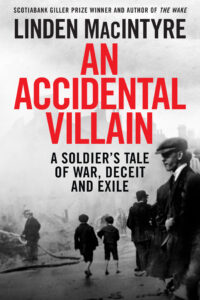
This interview has been lightly edited for length and clarity. An Accidental Villain is published by Penguin Random House Canada.
(Images: Tudor; Bloody Sunday Memorial; book cover)