

50 Years in the Building: Don Mikel’s Canadian Architectural Styles – Part 1
December 2025
Can we start by talking about the process behind Canadian Architectural Styles, because it represents decades of, not just writing on your part, but observation and field work as well.
Well, yeah, that’s true. I mean, I’ve been interested in this since I was a teenager. And I’ve been involved in heritage conservation groups as a volunteer throughout most of my life. I lived overseas for 16 years after I retired, and I started this book when I was overseas, and I actually got a chance to write it thanks to COVID. And then when I came home, I travelled from St John’s right across to Victoria, BC. I have a total of 75,000 images of Canada, which I distilled down to 1100. I’ve been observing buildings for years, and we’ve never really had a national guide in Canada that lays out all our building styles. I actually first proposed to do this in my 20s and it took me until my 70s to get around to doing it. So now it’s done.

What brought you to architecture, by the way? Were you a kid that liked to draw houses and come up with structural designs?
Well, I grew up in Cobourg, Ontario, which is a very old Ontario town. And I grew up in old houses, and my parents liked them, and so I just became interested, kind of by association. And I started going to architectural conservancy meetings in Port Hope, and that gave me a further interest.
Is there a Canadian Style of architecture or is it a matter of borrowing from different styles – Gothic, Greek Revival, Modernism – and traditions and using materials that are available here?
All of the styles that we have are international styles. And mostly from the English-speaking world, although not all, but what makes Canadian architecture distinctive is what we’ve done with those styles. And that has to do with different cultures, different choices of what works for us, different building materials. We’ve taken something that’s international, and we’ve made it something uniquely Canadian. And that’s why it’s important, because how we build and how we express ourselves in architecture is different from other countries, different from England, different from the United States, different from Australia. So, we have an important body of architecture that contributes to world architecture.
I was so taken with how the different periods influenced each other. There are few cut-and-dried beginnings and endings to a period, except for when you’re talking a style that’s named after royalty, like, say, Queen Anne. Sometimes they are concurrent, sometimes they push each other a little bit back and forth. You made this seem like such a living process.
I wanted to do that. Nobody else has really done … people usually produce books like this for a province or a city or something like that. And they take handbook examples. So you’ve got a handbook example of the Gothic Revival or a handbook example of Streamlined Moderne. And then when people go out to look for buildings, they don’t find [exactly what they saw in a] handbook, they find buildings that are a transition, an evolution, a mix. And so why there are so many illustrations, 1100, is to try and show, one, handbooks, but two, how these have been expressed differently in different places and different time periods. For example, you mentioned the Queen Anne Style. At the beginning of the Queen Anne period in the 1880s, it was very, very Victorian. But by the end of the Queen Anne period, around 1900, characteristics began to emerge in that style as it shifted towards the Classicism of the 20th century. So you can have a Queen Anne format and all Classical detail. So that’s what I try to express in the book.
I particularly enjoyed reading about, I’m not sure if I’m going to pronounce this right, Picturesque Style, and how it was influenced by a landscape painter.
Yeah, that’s interesting. And you did pronounce it right. And one silly thing, I don’t know if I put it in the book or not, but Claude Lorrain’s paintings were darker than everyday life. And the British, well-to-do British in the 18th century, would ride around in their carriages with sunglasses on, creating Claude Lorraine landscapes. And it just goes to show that people could be as silly then as they are now.

Do you have a favourite period?
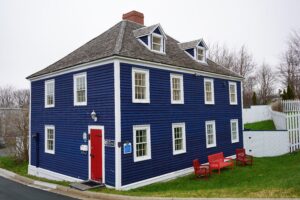
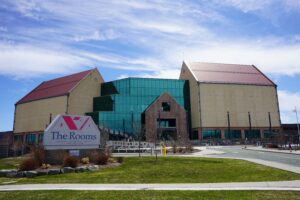
Uh, no, but I like a lot of periods. One of my favourite periods lately has been Streamlined Moderne. And you’ve got a really fantastic streamlined moderne building in St John’s, which is the American Aerated Water Company, [as it was called] in 1948. And the thing about Streamlined Moderne is it’s a very plain, usually flat roofed, and it has lines on the facades and they’re like speed lines. And I always worry about these buildings because people look at them and go, ‘oh yeah, no, that’s not worth saving.’ And they disappear. But they are a really fantastic design, and they’re kind of related to Art Deco. And what’s nice about St John’s is it isn’t just about old buildings. You’ve got some really great 20th century and 21st century buildings. And some really important architects. And you’ve got unique styles. For example, the early Georgian Style, like the Mallard Cottage and the Anderson house, they’re in what’s called the Pavilion Style, which is a rectangle with a hip roof. And that’s distinctly different from what you find in other provinces. And buildings like The Rooms are very modern, postmodern buildings, and they express a culture. And one really interesting modern building is the Fogo Island Inn, because it expresses the environmental and cultural aspect of the postmodern. The Fogo Island Inn is built on stilts, like houses in the region, and it was built so sensitively as to not disturb any of the local environment, which is unique in that area. So you’ve got lots of great things. I mean, I could go on and on about Newfoundland’s architecture.
I live in one of what a lot of people call a jellybean row.
Oh, I love those houses.
What about your house? What style is your house?
Well, it’s funny you should ask, because I’ve lived in old houses all my life, but I live in a new house now, because I lived overseas for so many years, and I live in a condominium now, and I chose it because I could just turn the lock and leave. But I have owned two Regency houses. I’ve owned a Greek Revival Style house. I owned an Edwardian house in Midland, Ontario. I’ve restored maybe five or six houses. I’ve also had a mid-century modern bungalow. I’ve moved around from house to house.

Check back December 29 for Part 2 of our conversation with Don Mikel.
Canadian Architectural Styles is published by Lorimar Formac.
(Images: Anderson House, Cubist Minimalist House, The Rooms, American Aerated Water Company, Jellybean Houses, courtesy Don Mikel.)