

“Not about battlefields” – Mary Sheppard’s WW1 spy thriller seeks to put Heart’s Content on the map: “I was also keen to showcase the strengths of Newfoundland women”
October 2025
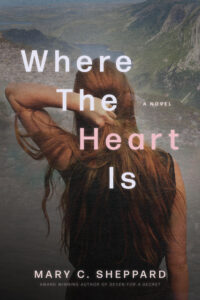
Congratulations on your new novel, Where the Heart Is! What inspired it? What do you think sets it apart from other historical fiction set in WWI Newfoundland?
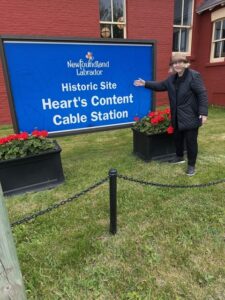
I wanted to write this book when I realized that I could blend some of the history of the cable station into a spy story that also allowed me to tell a small part of Newfoundland’s part in WWI. I was also keen to showcase the strengths of Newfoundland women. My novel isn’t about the battlefields; it’s about the people, especially the women, left behind in one small community. I also love the name, Heart’s Content, and I wanted the world to know that it is a real place with a very important history.
There are excellent historical fiction novels set in Newfoundland during WWI. I’m going to go out on a limb here and say that most of them are about the Newfoundland Regiment and the horror of the trenches. What sets Where The Heart Is apart, I think, is that it’s the first historical fiction set at the Heart’s Content cable station that made very important contributions to the history of communications and the outcome of WWI. Being able to deliver data on cables was the beginning of the data-driven world that we know today. The book is also a reminder that women’s workforce history isn’t linear. There have been moments in historical timelines when women have had pay equality, as in the two world wars for example, and at the cable station during WWI.
Although the Heart’s Content Cable Station and its sister station in Ireland have been submitted to UNESCO to be considered as a joint World Heritage Site, do you feel the cable station is still somewhat overlooked/unknown.
Yes, I do feel it is overlooked. People seem to know that Guglielmo Marconi sent a wireless message from Signal Hill and visit there for the history and the view. Modern tourists know about Gros Morne and L’Anse aux Meadows but every time I mention the cable station to people, I get a blank stare. The history is being lost. I would love for historical researchers to take on the task of doing a timeline of the iterations of technological changes within the cable station from its onset, to give the world a glimpse of the century of discoveries that got us to cell phones and AI today.
Is this your first work of adult fiction? How it is different from writing for Young Adults – or is it?
Yes, Where The Heart Is is my first work of adult fiction. I don’t think the writing is much different from my previous novels except perhaps for the complexity of plots and characters. Lucy Maud Mongromery, Louisa May Alcock, and JK Rowling’s Harry Potter series are young adult, though the term wasn’t used very much before the Harry Potter books. An adult can read any of these authors and enjoy them as I did when my daughters were reading them. My young adult books, Seven for a Secret, One for Sorrow and Three for a Wedding, were written for age14-and-up readers. I got some kick-back because of one scene in Seven for a Secret; I won’t go into detail, but let’s say it resulted in a pregnancy. Nevertheless, my publisher at the time felt it was a strong young adult book. Interestingly, most of my original fan mail came from adult women for those books. When writing for young adults I think the writer has to be more aware of the audience and keep away from too many nuances, spell out what you want to say, more so than in adult books. I’ve been told that Where The Heart Is has too many characters – I would have probably cut a few if I’d written it for a young adult audience.
In your Acknowledgements you thank historian Ted Rowe, who’s written extensively about Heart’s Content, and author Janet McNaughton, who assisted with historical accuracy. Can you give an example of something each spotted/helped you with?
Janet, Ted, and Where The Heart Is, are intertwined for me. Janet and I developed a friendship after Seven For a Secret was published. It was Janet who, several years later, casually waved from her car window and said “there’s the cable station” when we were driving by. I thought I knew a lot of Newfoundland history through reading and family stories, but I had not heard of the cable station despite its important role in world history. When I started thinking of using the cable station as a setting for a fictional story it was Janet who told me about Ted Rowe and suggested I absolutely had to meet with him.
Ted, a natural storyteller, was very generous with his time. He sat with me for a long lunch telling me story after story about Heart’s Content and the cable station. At one point he mentioned the social divide that developed when the early British operators created a very British ex-pat outpost in Heart’s Content that did not include the fishing families. The operators had regular salaries, big houses, furniture imported from England and the States because the cable company had put time and money into copying an English village to attract skilled labour. The fishing families barely made a living from the land and sea. It was at that point, even while Ted was talking, I knew that the social divide, or class structure, could be a good basis for a story. Stories need to be about change and/or conflict. After I started writing I joined Ted on one of his historical walks to get an understanding of the original layout of Heart’s Content. And of course, his book, Connecting the Continents: Heart’s Content and the Atlantic Cable, was the first research I did on the technical history of the cable station. When I thought the manuscript was perfect, I asked Ted if he could connect me with someone in Heart’s Content to read it. I was a bit nervous about writing about the community when I was a “come from away” – all the way from Corner Brook. He recommended Barb Payne who not only read the manuscript but gave it a final proofread to a very professional standard.
Janet stepped back into my book writing process as Where The Heart Is was near completion. I got a grant from the Writers’ Union for Janet to go through the manuscript to look for any historical inaccuracies that may have slipped in. Janet, with her PhD in Newfoundland folklore, was perfect for the job. It was humbling to be told that things I remembered from my childhood were just not true. I thought the manuscript was finished but Janet sent me 16 pages of detailed notes. There are so many aspects to history, for example, Janet noted that I had not mentioned prohibition, which was a hot topic during the period I had chosen to write about. Newfoundland historian Jenny Higgins sent along a research paper on prohibition, and I had to rework a couple of sections to include the views on drinking related to the time period. Janet also reminded me that there were a range of opinions about unwed mothers in Newfoundland in the early 1900s. Janet gave me a source to verify that orphanages in Newfoundland did not accept “illegitimate” children even as late as 1966. I had to swerve a little to rewrite my notion that Luce’s baby, born out of wedlock, could be sent to the orphanage and I also pivoted to have one character be accepting of the child. A third example is Janet felt in the version she read that I was too harsh on one of the secondary characters, Anna, an albino, and her marriage prospects. She said her research showed that Newfoundlanders were remarkable at accepting differences and that historically all capable women were in demand as wives. I changed Anna’s backstory a little to include her more in society and gave her a husband in the Epilogue. By the way Anna was partly based on an albino woman, who married a very popular fisherman, in the community where I spent some of my childhood.
What are the plusses and minuses of self-publishing? What have you learned? I have learned a lot, mostly that self-publishing is not easy, it is not for the faint-hearted and it is expensive. I followed a helpful guideline developed by the Writers’ Union of Canada. Still, at the beginning I was lost at sea. I learned the technology of the Kindle publishing site by uploading my first three novels. I had edited them and wanted them to stay in print. Almost immediately an Amazon bot rejected my two Penguin books. Amazon Kindle sent an automated e-mail saying my books were rejected for one of the following eight or nine reasons. I had to figure out the actual problem for myself and then fix it. The email ended with something like, “you have been banned from Amazon. Your account has been removed. You are blocked forever.” In my case it turned out to be misunderstanding by the Amazon bot over copyright. I had the legal transfer document from Penguin and the whole process was reviewed, and my books were put back up.
Once the very fidgety technology was under control there was the frightening moment when I hit the publish button for Where The Heart Is. The writer has to be confident that the book is good enough for major scrutiny. In retrospect I probably made an error by putting my manuscript on Amazon for a soft launch late in the fall. I thought I would sort out all the tech issues and then load it again later. But once it is on the site, Amazon maintains that is the publishing date. So I was stuck with a November 2024 publishing date when I really wanted it to be January 2025. Lesson learned and now handed along to anyone who might be considering self-publishing. There are companies that will guide you through all of this for a price, but I have good technical skills, so I decided to do the uploading myself.
As mentioned earlier, self-publishing is costly. For Where The Heart Is I hired an editor, a cover designer, and a publicist. A proofreader went over the final manuscript. Only after I had the book on Amazon did I realize the enormity of getting the book noticed. The publishing industry has tight control of the book marketing machine. It is quite daunting to get any notice for a self-published book. My publicist recommended a cover design change. I had an ad designed and placed. I sent books to many literary editors at my personal cost. Interestingly it turned out to be most expensive to send books to Newfoundland because of the provincial fuel surcharge.
Despite all these pitfalls, I am happy that I went the self-publishing route. It might have taken a couple of more years to get this book published and I wanted to move on to my next project. I had a very good agent who sent earlier manuscripts of Where The Heart Is to several publishing houses who were complimentary, but either the timing wasn’t right for them, or they weren’t sure the market for the book was big enough. Each submission to a publisher can take six months to a year to hear back. I am a voracious reader with three published books under my belt, and I thought Where The Heart Is stood up to many books I had read. My beta readers were also very encouraging, so with great trepidation, I chose to self-publish. I know from my own experience that for publishers you are a one-season wonder. With self-publishing I can continue to promote the book and continue to encourage libraries to buy it for their communities.
What’s your next project?
I am writing a spy novel. I tend to like mysteries. It is almost done but I was just in the UK, and I got some ideas that I plan to work in. Also I want to change the background of one of the characters so those two things will take me most of the winter to fine tune. The story is about a young woman, a master of disguise, who seemingly lives a quiet life in a rural condo community, but she is in fact the centre of an international spy drama. It’s called The Last Duchess, and parts of it take place in Ontario and in Newfoundland with a British connection. Pure fiction and fun with insights into how technology has created a whole new spy world.
For more information or to purchase Where the Heart Is, click here