

Beyond the Frame: The Passion and Power of Grenfell’s MFA Exhibition
May 2025
Story & photos by Blessing Adedokun-Awojodu
If Grenfell’s Department of Fine Arts had been awarded millions of dollars in unrestricted grants, it could hardly have been more ecstatic than it has been these past few days, and rightly so. The achievement of graduating some of the finest emerging talents in the contemporary art scene is nothing short of golden; a win worth every bit of the celebration. In a conversation with the graduating class of 2025, I was granted a front-row seat to some of the most inspiring stories of grit and triumph, not only through the personal narratives of the artists themselves, but also in the fine lines and textures of the experiences captured in their work. This collection is as diverse as it is distinctive, reflecting the multiplicity of identities and backgrounds that characterise the Memorial University’s MFA program. Presented under the theme LOCUS, the MFA Class of 2025 at Memorial University unveiled their latest body of work–an extraordinary exhibition of pieces meticulously researched, and painstakingly developed. The exhibition launched at 5 pm on May 23rd at the Grenfell Art Gallery and will run through June 21st, giving viewers a compelling glimpse into the minds and methods of the latest graduating artists.
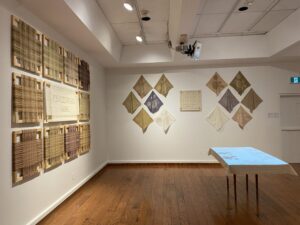
In an exclusive interview, Jane Walker, the gallery director, spoke passionately about the demanding process behind curating such a stunning collection. As she led me through the gallery housed within the Fine Arts building on Grenfell Campus, the space revealed itself to be nothing short of breathtaking: delicately painted walls, careful lighting, and a thoughtfully partitioned layout formed the perfect backdrop for the art on display. Jane’s role, as she explained, involved working closely with each artist to ensure the installations harmonised with the gallery environment – or that the gallery adapted itself to the needs of each piece. “How hard could that possibly be?” one might ask. Jane’s response: “The reason these installed pieces, or any installable artwork for that matter, capture the audience’s attention is because the curator has done the hard work of noticing and refining what matters most.” She went on to reveal that the most important element in any exhibition is not just the art itself, but the space in which it lives as the space can either elevate or diminish the power of the work. And if LOCUS is anything to go by, this exhibition elevated the work beautifully.
Jane also shared some personal reflections, speaking with deep emotion about her experience working with the artists. She described them as passionate and intellectually profound. Beaming with admiration and gesturing animatedly, she praised both the artists and the MFA faculties as “trained professionals who refuse to produce anything less than the very best.” Collaborating with artists at various stages of their practice to bring their creative visions to life is one of the aspects of her job she finds most fulfilling. A widely traveled alumna of Grenfell’s Fine Arts Department herself, Jane expressed great pride in contributing to the growth and success that both the department and the gallery have recorded in recent years. She also shared the gallery’s interest in hosting more exhibitions from both emerging and established artists within and beyond the province. Her invitation was clear: all interested artists should consider the gallery as a potential home for their work. Speaking with Jane deepened our appreciation for the gallery’s pivotal role in this exhibition and endeared us even more to all that LOCUS stands for.
The inspiration behind the LOCUS collection is just as compelling. Each artwork tells a story steeped in reverence, love, community, and boundlessness. For Ernest Boateng, whose primary medium is photography, the focus lies on the lives of handymen. Those whose work is often hidden behind hardware, machinery, and tools, and who are frequently unnoticed and underappreciated. His project gives visibility to these “invisible heroes,” whose unbending spirits twist, carve, and build the infrastructure of our everyday lives. Through fabric laminations of work clothes, intimate portraits, and glimpses into moments of joy and work-life balance, Ernest reframes how we view, for instance, the motorcycle mechanic. As a Ghanaian living in Newfoundland, Ernest emphasised that building trust and forming personal relationships within the community was vital for this project, given that he was documenting deeply personal and often private aspects of people’s lives.
Another moving collection at LOCUS is The Stories of the Land by Seema Kachroo, a series that speaks profoundly to community, heritage, and cultural continuity. Drawing from her Indian roots, Seema uses paper and ink to craft works inspired by lost and evolving cultural elements. As an immigrant Canadian shaped by various Indian cultures, she explores the emergence and erosion of language, religion, and community. Her work is, in her words, “the archiving of cultures”. You could call it a poignant response to displacement and historical erasure.
Tessa Graham’s textile-based pieces, titled Like Home and The Table’s Been Set Before (Me), are created from cotton, wool, and natural dyes. Tessa is inspired by family, environment, and the sacred ritual of dining together. She spoke passionately about the deep communion that happens around the dinner table, and the ache of longing that follows the loss of those once seated there. The recent passing of a loved one during the early stages of her research deeply informed her work, lending it a tenderness that is both personal and universal.
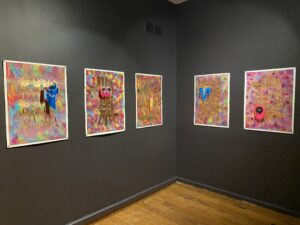
Equally breathtaking is the work of Kate Jackson, whose textile background merges brilliantly with technology. Using fringed, ornamented costumes, Kate “trained” rapid prototyping machines to dance–yes, dance. These choreographed movements produced intricate golden patterns that suggest a kind of mechanical emotion. Her work, Dancing Machines, is both mesmerising and innovative. Kate explains that the piece emerged from her curiosity about “the creative and sensual capabilities of machines,” and that she sees herself as collaborating with them to produce a dance music video with distinctly queer aesthetics. Watching the final video, one can only marvel at the truth of her claim: what the mind can imagine, art can, indeed, bring to life.
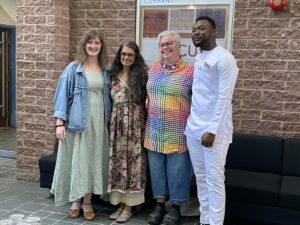
(From right to left: Ernest Boateng, Kate Jackson, Seema Kachroo, and Tessa Graham)
Together, these artists, their works, and the curators behind LOCUS have offered us a powerful, soul-stirring experience in a collection of sights and stories that will linger in our memories for a long time. We count it a privilege to have witnessed it.
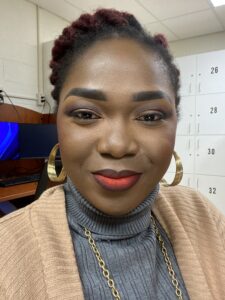
Blessing Adedokun-Awojodu is a writer, educator, and sustainable fashion researcher based in Newfoundland and Labrador. With a background in literature and a keen eye for cultural storytelling, she brings thoughtful insight and emotional depth to profiles, reviews, and features. Her work often explores the intersections of art, identity, and community. When she’s not writing, Blessing facilitates creative workshops that empower people through fashion, sustainability, and self-expression.