

Like an open book: Karl Wells releases his memoir
July 2025
Congratulations on your new memoir! I knew Openly Karl was going to be interesting – but it was a page turner. I could not stop reading it – and I did not expect to feel so sad at times.
It made me sad at times writing it. It was difficult, actually. Some of the stuff that I wrote was difficult to write, and a couple of times, more than a couple of times, I think I actually had to get up and leave the room and stop writing.
What were the hard parts?
Well, it was hard writing about the bullying. I guess I left it till the end of the book because I was going in a chronological line, but I found it difficult to write about the prolonged episode of bullying I went through at the CBC. It was just one individual. I mean, I certainly experienced homophobia in the workplace, but the homophobia, that wasn’t just at the CBC, that was outside the CBC as well. But it was unexpected in the workplace. But I handled it. The homophobia wasn’t anything that really affected me badly in a psychological way, but the bullying, that was different. That was in a class all to itself. That was pretty horrendous. I was shocked, actually. I was I was badly affected. I left the CBC in 2007, and I would have nightmares about it regularly for years. I didn’t really want to go back there. but I felt I had to. I just felt compelled to and I’m glad I did. The other evening at the book launch – Rhea Rollmann interviewed me – I said, I feel at peace in a way, because it’s like I put certain ghosts to rest.
You’re so honest, too, about your reaction not just to this, but also an episode when you were a high school student at Prince of Wales, and swarmed and groped by.a group of students. It was interrupted by a teacher entering the classroom – but the teacher’s response was also upsetting.
It was horrible. It was really horrible. The teacher just sort of smirked. I just felt like I wanted to crawl under the bench.
It reminded me teachers in that era were often not nice.
And kids would get hit at school.
I remember we got cracked on the knuckles. This sounds like I went to school in Dickensian times because when I went to Holloway School, it was really styled on the British public school system. And the teacher I had in grade three, she had this long pointer that you pointed to, whatever, England, on the map. And one day, I don’t know what it was, somebody had done something bad, in her estimation. And she was trying to get us to get that person to fess up. And she said, ‘If you don’t admit who you are or admit you who did this, you’re all going to be punished.’ And so nobody would admit to whatever the infraction was, whatever the great sin was. We all had to lay our lay our hands on the desks. And I was thinking, what’s going to happen? She took the wooden pointer and very methodically went from pupil to pupil, right across the knuckles.
Now, of course, it’s not all dark in the book, there’s a lot of love there. I felt your love for your parents.
Yes.
And theirs for you.
I wrote in the book that my mother, she got frustrated easily and she was stressed easily, suffered anxiety easily, and so I know that raising kids wasn’t easy for her. And she didn’t get that much support from dad because he was working all the time. He just worked every hour that God gave him, so to speak. And it was tough for her, but when I got older, I thought that my sister, my brother, were the really difficult ones because she said to me, ‘Oh, you didn’t bother me at all. You never gave me any trouble.’ And there’s a big age difference between my brother and sister and I, eight, nine years. And so they were teenagers and I was still a young child. I ended up spending more time alone with my mother than anybody. There was a definite bond between us, and I really loved her and loved my father, dearly, and wanted to protect her. My father was killed, in 1978, in a car accident and I wanted to protect her and look after her, and did, right up until she left us.
You include so much detail. Did you keep a diary or you have a really good memory?
I do. Well, for things I want to remember, for things that make an impression on me, be they really joyful or really traumatic.
Yeah, I do. And I hope I don’t lose it.
Even for what your apartment looked like when you were a little boy.
Yes. Yeah. Now, some of the stuff when I was in Buchans, I wouldn’t have any memory of that. But I remember my mother and father, and especially my sister, talking about those years in such detail, I never forgot those because Buchans was painted as being almost like a magical place to me because it was very clear that these were very happy years for my parents and my sister. And so they would talk about Buchans, and I would soak it up. But once I started the book with the very first memory, and from that time forward, I could remember pretty much everything that ever happened.
Did you any fact checking? Did you verify anything?
Yes. Oh, yes. And Breakwater did too. Claire Wilkshire did the substantive edit on it. Excellent person. She would call me frequently or send me an email and say, ‘What’s the source for this?’ I would send her a photograph or send her the information she needed. And of course, for a lot of it, I did keep contemporaneous notes, certainly about the bullying and all of that, because that ended up becoming a big deal. You know, that was a case at CBC and so I had a lot of material on that, like things that people had said to me. It was all written down. I wrote everything down. And I’m a pack rat, too, Joan, I’ve kept all kinds of photographs and notes and scripts that I’ve voiced and performed, like Ray Guy‘s scripts and all of that stuff. So I had a lot to refresh my memory. An awful lot.
You don’t name everybody. But you name John Furlong.
And the book was lawyered. Breakwater wanted it lawyered. They wanted a lawyer to look at it. So I did have a lawyer go through the entire manuscript and he told me who I could name and who I couldn’t. The people who were named were named because they’re dead.
In your introduction, you say if you’re using a pseudonym for someone, you just put it in quotation marks when you first mention it.
Some of those people were named and I was advised not to use their name. Not because of any legal issues, but simply because Claire would say to me, ‘I’m not going to fight with you on keeping that in there, but I just want you to know that sometimes after a book is published, authors have regrets about naming certain people, and it causes hurt feelings and whatever.’ So I said, ‘Yeah, I agree with you.’ And I acquiesced and came up with that idea.
That is so elegant. That should be the new rule.
And it turns out there was there was one person, I thought she’d be mortified [this concerned a young employee behaving so unprofessionally in the control booth Karl had to gently chide her while he was actually on the air]. So I said, ‘I’m going to give her a pseudonym.’ I called her Stacey. And anyway, at the launch, she thought the story was so funny, she was going around telling everyone, ‘I’m Stacey, I’m Stacey!’ I thought, Well, you’ve just blown your cover. [laughs]
You’re also very open with your mental health struggles.
Yes.
How are you feeling today?
I still have some issues, but nothing serious.
Good.
I do this thing, and I don’t know why, but when I’m putting a knife back, we have this knife block, and when I’m putting a knife back in that block, I have to go, bang, bang, bang, bang. It has to be four times. One, two, three, four. And it’s got to sound a certain way, and it’s got to feel a certain way. And it’s almost as if I’m trying to make sure that it’s in there and it’s securely in that block. That’s the one thing that I can’t stop doing. But apart from that, that sort of thing was never the thing that really made me want to literally lose the will to live. It was the intrusive thoughts. These thoughts that I would have, and crazy, crazy things like that I’d be on the air and I’d have this thought that I was going to blurt out something in front of 100,000 people watching, something obscene, vile, disgusting, and it would just be so terrifying. It would just grip me. And this went on and on and on for years. And eventually, I said to Larry, ‘I can’t take it anymore. I can’t handle it anymore. I’ve got to get some help.’ And I went to see my doctor and I just unburdened myself. And thank God I was put on this medication, and it worked.
I knew you were so open about your sexuality, but I never suspected at all that you were struggling with something like that. Did you hesitate to put that in or was that always just going to be part of your story?
The OCD?
Yes.
Oh, no, I intended to put it in, but I have to say in the manuscript, it was touched on briefly, and Claire, after she’d read the manuscript, wrote me a very long, detailed, and helpful letter telling me what she saw as the three basic themes of the book. And one of them was OCD.
What were the other two?
Oh, the other two were my experiences as a gay man. and the CBC, basically. My career with CBC. She said, the content in terms of my life is as a gay man, and what I went through and the homophobia, and the CBC, that’s fine, but she said, ‘I really think that you should expand more on the OCD because I think it would really, really be helpful to people who have family members who may have OCD or people who have OCD.’
What do you hope people take from the book?
When I started the book, I didn’t know Rhea Rollmann was writing A Queer History of Newfoundland. Rhea approached me when that book was in its writing phase and interviewed myself and Larry, and I told her then I almost have a book finished. Obviously, there’s a lot in her book that’s not in mine. But I was actually thinking when I started writing the book that there was nothing basically covering this whole period, you know? And I had spoken with a few young LGBT people, and I got the impression that they were thinking that Larry and I were kind of like dinosaurs who came from the olden days, way back and they really didn’t know any much about it. They really didn’t know much about it. And we lived through a really scary time. When I was a very young boy, I found out what homosexuality meant and that homosexuality was against the law, you could get into trouble for being a homosexual. That was really scary and growing up under that kind of dark cloud wasn’t easy and I’m not saying it isn’t easy for young people today because God knows it isn’t. Especially with social media and the kind of bullying that you experience on social media, sometimes it can have terrible consequences. But I had I thought a unique story to tell. And especially with having become a public figure, and we lived through that horrible AIDs era, right from the very beginning when nobody knew what it was and it was just this these stories about people in San Francisco, New York, becoming ill and dying and nobody could figure out what it was and people, crazy people, were saying, ‘Oh, it’s God’s vengeance.’ And it just went on and on and on and on through the 1980s and through the 1990s and it was awful. And I just felt I wanted to write about that too. But basically, just to let the younger generation, the I guess the millennials and the Gen Z people, know what it was like.
Is there something I haven’t asked you that you’d like to say about your book?
I did have a marvellous time, generally, during my CBC career. I don’t want to give the impression that I had to experience homophobia day in, day out for 31 years. I didn’t. I mean, it was just something that people found out, everybody knew, very, very early, because as I wrote in the book, I was not closeted. I was not closeted when it comes to everything that went on outside the CBC. Larry and I have been together for 46 years and we’ve lived together, we’ve done everything together for 46 years and all our friends knew we were gay. We went to gay bars, gay clubs, gay dances, blah, blah, blah. We were very, very open and I never denied that I was gay. I never pretended I was anything else. I just didn’t talk about it at work, and nobody asked. Don’t ask, don’t tell, right? But obviously, they knew. And some of them who were homophobes, and made sure that that I knew they knew that. And that was uncomfortable. But that’s one of the reasons why I chose not to talk about my sexuality at work or to talk about my private life, really. But there were lots of great people I worked with and had joyful times with and people who helped me in my career that I’ll never, never forget. And allowed me to do things that enriched my working experience. It was great. And I had an eclectic experience at CBC. I got to do more than pretty much anybody else. I acted, I produced, I did television, did radio. Did variety, did news.
It was nice to be reminded of what CBC used to be here.
It was very much a cultural institution. Whereas today, it’s focussed on news. There’s no in-house production of anything, really. We had set designers, and they were designing sets for dramas and variety shows, and it wasn’t just news. News was just a small part of the whole operation. So much of it was so exciting. And again, cultural. And all produced in-house and it was the same at every CBC production centre across the country. But now, it’s completely changed.
Are you doing any acting these days or are you interested in doing any acting?.
I’m always interested in acting. I did do, which I’m quite proud of, I talked Rogers into letting me do a one-man performance of A Christmas Carol. I had done it [as a stage production] for years and years and years. And so I convinced them to let me turn it into a film, and they gave me the resources and the people to allow me to shoot that. I produced it and wrote it and everything. It airs every Christmas. We shot it at the Commissariat House, which was perfect. Absolutely perfect for the story. It turned out really well. It’s on YouTube, if you want to watch it.
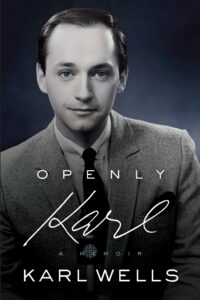
Openly Karl is available from Breakwater Books.
This interview has been lightly edited for length and clarity.