

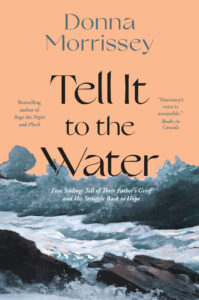
“Our strongest bonding is the sense of humour we cloak around our crippling selves”: Donna Morrissey on her new memoir, Tell It to the Water
September 2026
This memoir, subtitled Five Siblings Tell of Their Father’s Grief and His Struggle Back to Hope, is published 17 years after your father’s death. Were you working on it all along, or did the time suddenly seem right to tackle this subject?
I started working on this project about five years ago. I wrote two separate drafts before I was able to ‘find the voice’ for it. Initially, the idea grew out of a night of sitting around the ‘family table’ with my siblings, yarning about Dad. I was enthralled by the boys’ stories [Glenn, Tommy]; there was so much about my father and brothers that I didn’t know. Girls [Karen, Wanda] don’t have the same relationship with their father as the boys do. We know our mothers. I wanted their stories, their experiences and insights and suggested then and there, “Let’s write us book about Dad and all of our stories.” Everyone cheered, yes!!! Course, that was on our fourth bottle of wine …
The format is so engaging, with different chapters devoted to the different voices of your family. How did you select what stories to tell? How did your family feel about you writing about them?
Lord, there were sooo many stories, and yet the ones that fell into alignment with the structure and time-frame of the manuscript stood out.
My siblings were one hundred percent supportive of the idea. Course, getting the boys to write out their stories was no easy feat … they lived in camps in Alberta, sent me writings on bits of paper, photographed and sent on messenger. Most of them were indecipherable … blurred, upside down, sideways, off-centre. Yet, I was astonished at how easily they went into their more intimate moments.
What I didn’t get from them on paper, I got during phone calls, visits, etc. Looking back, it astonishes me how easily it all flowed … the stories, the sequencing, their voices.
I kept trying to think of the word for your family’s ‘love language.’ You often have each other ‘drove’ (but you also have each other’s backs). You don’t gloss anything over. Was that a choice you made from the very start with this material?
Aside from structure, I didn’t consciously think anything about how to portray their stories. I told them honestly as they told them to me. We’ve suffered so much tragedy and trauma together as a family, that we’re bare-naked to each other emotionally. It’s our norm to laugh, yell, fight, play with [no] holds barred. Our strongest bonding is the sense of humour we cloak around our crippling selves. Plus, the behemothic love we hold for each other, a legacy from our parents, and ironically, the tragedies.
You’ve published both fiction and autobiography – how do you switch from one genre to another? Do they share the same challenges? Were there specific challenges to writing this memoir?
It was relatively easy to switch from fiction to non-fiction. Everything I have ever written was inspired by my family, the things I’ve experienced and/or witnessed. Fiction has a way of hijacking a story, a character. I was never able to control the narrative to tell the story I really wanted to tell. One day I said ‘enough of that. I’m gonna write my story. The way it really was.’
The challenge, of course, is the emotional content a character always carries. With non-fiction there is no buffer between you and the emotions the story evokes. That was tough in places.
What is relatively easier with nonfiction is you know the story. It is a simpler matter of selecting the scenes that will help knit together the larger story. And yes, it can be challenging to discriminate between moments that are necessary and those of self-indulgence. But nothing a good editorial eye can’t discern.
What’s next for you?
I’ve started a new novel about … eh … well, it’s fiction … so it’s already getting hi-jacked from where I want it to go. Who knows, at some point I just might swap it out for memoir and stick to the facts …
Donna Morrissey is the author of the nationally bestselling memoir Pluck, which was a finalist for the Atlantic Book Awards’ Non-Fiction Award, and of seven acclaimed and bestselling novels, including the national bestseller Rage the Night. She won the Thomas Raddall Atlantic Fiction Award and the Arthur Ellis Award for Best Crime Fiction for The Fortunate Brother; Sylvanus Now was shortlisted for the Commonwealth Writers’ Prize; and The Deception of Livvy Higgs was a One Read pick for Nova Scotia in 2017. Her fiction has also won awards in the US and the UK, and has been translated into several languages. Born and raised in Newfoundland, she lives in Halifax. Tell It to the Water is published by Penguin Random House.
Morrissey is scheduled to read at The Rooms October 16.