

Take Shakespeare, add toutons: NQ talks to Paul Rowe, director of a new production of Merry Wives of Windsor
August 2025
Congratulations on the new play! Can you talk about how you adapted the script to a 100-minute running time?
It took it was an elaborate cut.
And it was an ambitious cut because Falstaff has an entourage, a bunch of rascals that are also carried over from the history plays with him: Bardolph, Pistol, Nym; they’re all there creating trouble.
And there’s another whole storyline that involves that Dr Caius, who hope to marry Anne Page. That is also quite elaborate and there’s a fake dual set up.
The first thing was to try to go down to a manageable size but then still have something left that was seamless in terms of how the characters and the story unfolded. And I think I succeeded. One of my colleagues said that I had kept all the funniest and the fastest bits and cut everything else. And I think to some degree that was true.
It moves really well.
The whole play revolves around Falstaff and the Merry Wives – MIstress Page and Msitress Ford.
And I think those are genuinely the funniest parts of the play.
And you added in some local references – to toutons and moose stew, for example.
That’s just a personal license that I will take with the plays. I mean, they can be very deeply adapted, made into musicals and whatnot. Or people can be real puritanical about trying to do even the whole text, like Kenneth Branaugh did in his Hamlet.
But I just feel like sometimes it’s nice to give a local flavour, and it’s also I’m encouraged to do that because the original references in those cases are often very obscure, something which would have meant nothing to a 20th century audience. I gained additional license by the fact that the play was happening in real time in the hotel, and so it just brought it all into the modern day. Another thing I did, of course, was reference Beck’s Cove, and the harbour.
I took a kind of personal license with the material since it’s no longer copyrighted, and you don’t have to get permission to add those little bits.
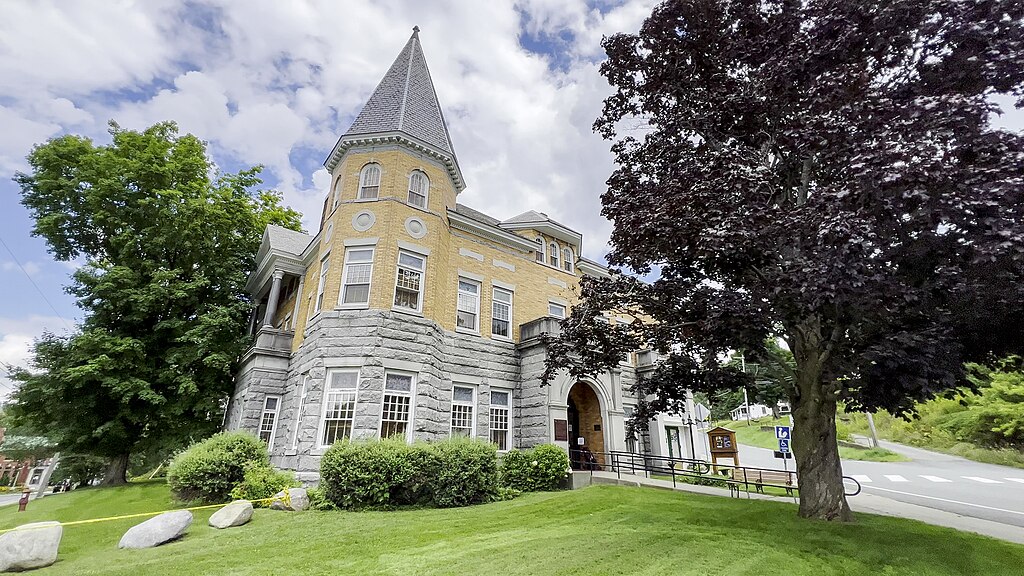
What about the site? When did you know that you were going to be staging it at all in the Alt Hotel courtyard?
Sharon King Campbell, the artist director, contacted me and said, would you be interested in directing? And I said, sure. She said, well, think about a play that you’d like to do. And I couldn’t really think of one. But when we met, she said, I would like to do Merry Wives. And I thought, perfect, what a great choice.. Because I’ve seen it three times. And so I know it fairly well. And it’s a fun piece,. Then I learned about the Alt. We had a meeting with them. and they were very helpful and very cooperative, and they did say that they wanted something that wouldn’t be, you know, like too long, definitely under two hours, which I I thought was going to be a bit of a challenge, but as it turned out my cut was just right on there.
And you really incorporate the space – for example the characters are wearing nametags on lanyards as if they’re attending a conference.
There’s the logic to it. People do enjoy that very much. People, for example, seem to get a big kick out of that little simple device where Ford [Dave Walsh] says he’s in “inscrutable disguise,” and he just changes the lanyard.
And they’re constantly entering and exiting through five doors opening onto the courtyard.
There is a bit of a danger because [the playing area] is so long, so wide, that action that takes place on one end could be challenging for people [to see and hear] on the far end. So we try to keep it moving, keep it to the centre as much as possible.The audience dynamic is different for every show. it’s an unusual space in that it is so long. And I enjoy the fact that the actors and the audience are in such intimacy.
That’s a really positive thing.
That orientation is a challenge, but it worked particularly well because it was conceded is that it’s a conference nd it makes sense for everybody to be coming through the doors. But if you were doing something else, perhaps you’d just orientated the scene towards the harbour which would be a wonderful backdrop, and you could do almost anything because you could create your own time and place.
You have the advantage that it’s not as windy there. You’re in the shade by six o’clock in the evening. It’s a lovely space, and a kind of a public space. Shakespeare by the Sea has been moving around a lot lately – from Logy Bay to Signal Hill to Bannerman Park. Maybe this will become a space that we’ll identify with.
Is there a Shakespeare play that you have been longing to direct or act in?
Well, I’ve kind of made it my mission to, especially with directing Shakespeare, to do plays that wouldn’t otherwise be getting done. The plays that are just off the main map. You get the great tragedies and the great comedies that come up again and again. A play that I’ve been nursing for a long time is Measured for Measure, which I have a cut done of it. I’ve just never had an opportunity to do it. As for acting, maybe someday it’d be nice to play King Lear, take that on.
Is there anything that I haven’t asked you about the play that you like to share?
One of the things I pride myself on is, like someone mentioned to me that they felt that the ensemble was strong. And I kind of pride myself on that. You want to get a sense of the overall dynamics of the company where they all work well together. Then you just want everybody to be suited to the work that they’re being called upon to do, according to their level of experience and what they can bring to it. And some of that is even how you do the cut [of the script], so that you’re not giving people things that are really, really difficult for them to be able to say, or maybe they can’t reach a level of emotion that would be required for that role. So I’m just trying to conscious of that. When somebody says, oh, the whole company was really strong, It seemed like everyone was uniformly good, I think that is a real compliment. That’s not just a fluke. It’s done by design. That everybody’s very suited for what they’re doing and we all work together. I think it’s characterized my work so far with the company.
Shakespeare by the Sea is a volunteer company. We’re an outdoor company. We can’t do three and a half hour productions. A two-hour cut is about the outer limit of what you can reasonably do. The really good stuff which is easiest to comprehend and manageable for the actors and when you can get all that working, everybody on stage seems like they’re doing a really terrific job. There’s nobody being called upon to do something that’s beyond what they can do. So that’s kind of my philosophy.
The Merry Wives of Windsor continues until August. For more about the Shakespeare by the Sea Summer of Fun click here.
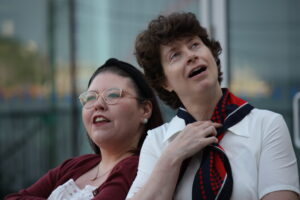
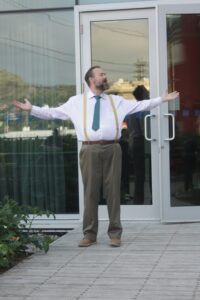
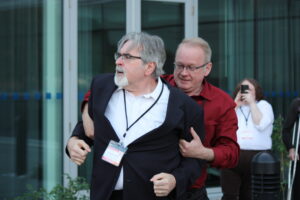
(Photos: Sandra Mills and Megan Jones as Mistress Page and Mistress Ford; Chris Hibbs as Falstaff; Dave Walsh and Chris Eustace and Ford and Page, courtesy SBtS.)
This interview has been lightly edited for length and clarity.