

Marc Garneau February 23, 1949 – June 4, 2025
June 2025
It was just last October that we spoke to astronaut and federal minister Marc Garneau, who has died after a brief illness, age 76. He had just published his biography – in his memory we present some moments from our conversation: “I STILL HAVE A WIDE-EYED VIEW OF THE WORLD”: MARC GARNEAU, CANADA’S FIRST ASTRONAUT AND RETIRED LIBERAL MP ON THE RELEASE OF HIS NEW MEMOIR
Congratulations on A Most Extraordinary Ride; it’s a great read. For example, in your descriptions of your three space flights, you display a knack for creating such vivid pictures that still leaves us wanting more.
Thank you. I’ve had 40 years since my first flight, and over 20 years since my last flight, to try to find the right words to describe what the experience is like. And I have to say it’s one of the most difficult things to do. I at one point came to the conclusion there are certain experiences in life that are almost beyond our ability, using words, to describe. It had been challenging. Sometimes in the course of the past 40 years, when I’ve been making presentations, I’ve felt I’ve come close to it, I usually I have slides to accompany it, which I think brings the listener or viewer closer to the experience, but it is very, very challenging to really do it justice because it is such an extraordinary and unusual experience. So I tried my best and I agonized over how to describe it.
Did you happen to see when William Shatner went up in space?
Yes I did.
I thought it was fascinating when he exited the Blue Origin and you could see him process that experience in real time.
Yes, I saw it, and it was very, very clear it had had a powerful effect on him. And in his particular case the whole experience was compressed into a very, very short time. In my particular case I can assure you I was just as starstruck by the experience of what I had lived, in my first flight, but it took me a while to find the right way to try to express t. I can remember in particular making one of my first presentations 40 years ago, and I has a NASA film with me because we recorded film of our flight and the things we do during our flight, and I was presenting that and talking to it, and after the presentation I took questions and one person said, Mark you did a very good job of explaining what you did on your flight, but you didn’t tell us what the experience was like for you personally. And then he used the sentence, and I’m quoting him directly, Marc where is your soul? And it struck me that that’s what people wanted to hear, they wanted to vicariously experience e it with me, and they needed to understand what kind of emotions and feelings I had when I was experiencing space flight. Yes, they were interested in knowing what science experiments I did, but much more than that. So I’ve been trying for 40 years to do that justice.
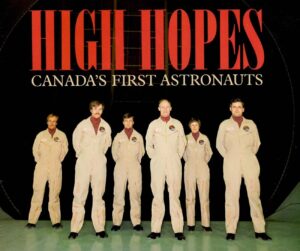
How do you handle the fear, or prepare to handle the fear, those moments of blasting off, you know what can happen, we’ve all seen what can happen?
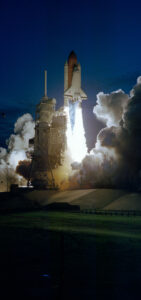
I would say that to some extent the first time you do it you don’t know how you’re going to handle it. Ad I was focused in the runup to my first flight on learning what I would be doing, in other words learning the science experiments that I was going to execute while I was up there. And it was really only when I was strapped into the vehicle with the countdown proceeding and I had two and a half hours in front of me and I kind of wished we could have compressed that and gotten off really quickly. But I was left to myself for the two and a half hours, as were my fellow crewmates, and a lot of things go through your head. Suddenly you realize, well this is it, it’s no a simulation anymore, in two and a half hours we’re going to light up the solid rocket booster and the main engines and we are going to go into space. And of course that kind of endeavour carries risk with it. And so yes I had some butterflies in my stomach which I think is normal for just about any thinking human being who understands what’s involved, so I had to think to myself how badly did I want to do this? And my conclusion was, yes I am accepting some risk, I think it’s manageable risk, and the reward from this is that I will have this extraordinary experience of being, in my case I was the 150th person to go into space in all of humanity. That was just too powerful an attraction for me to allow fear to take over.
Looking broadly at the book, is there one lesson might not be the word but one bit of advice or example you would like readers to take from your life story?
Yes, because I originally wrote it for my children. What I wanted them to see was there may be a public perception that I’ve had this charmed career with all sorts of successful things happening to me, but that really I’m no different from a lot of other people who’ve had some setbacks in their life, some personal tragedy, that I made stupid mistakes when I was young, but learned from those mistakes, fortunately was guided by good parents, and that life isn’t over when you screw up once or twice or even three times, you can still have a very, very wonderful life if you learn from the mistakes that you’ve made and the failures that occur in your life. I wanted to get that message across. When I get interviewed people tend to focus on my space career and my political career, but I think they need to look at the whole thing.
My last question is can someone who’s had your career possibly have a bucket list? Is there something you still haven’t done that you’d like to do?
(laughs) I’m still as curious as ever about life, and I’m still as adventurous as I was. I will not come out of retirement, I’ll say that. But I still have a wide-eyed view of the world, I’m still an optimist, and I still enjoy life tremendously. My bucket list is smaller: some travel, turning into a decent cook, doing a few things that are helpful in society, in other words giving back, those kinds of things, but mostly I want my life to be centred around my family now.