

William Malone Logs His End of Watch
July 2026
Can you tell us a little about yourself and how End of Watch came about?
I’m originally from Newfoundland and Labrador and grew up in the town of Mount Pearl, long before it became a city in July 1988. After high school, I headed to St Francis Xavier University in Antigonish, Nova Scotia, and graduated with a Business Administration degree in 1987. The following year, I joined the Royal Canadian Mounted Police and spent the next 26 years in uniform, serving in New Brunswick, Ontario, Newfoundland and Labrador, and on overseas deployments to places like Afghanistan, Haiti, Thailand, and several countries across western and southeastern Africa. I retired from the RCMP in January 2015.
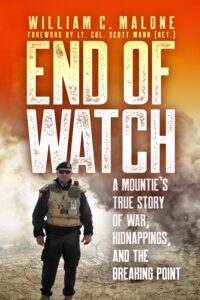
In the years that followed, I often found myself looking back on the work I’d done and the toll it had taken on me and my family. The decision to write End of Watch grew out of storytelling work I was doing with retired US Army Green Beret Lieutenant Colonel Scott Mann. Scott talked about how our mental wounds and scars can be harvested and repurposed to serve others, and that idea stuck with me. Together, we began examining how my experiences and struggles as a police officer might be used in that way. Scott’s guidance and wisdom were important, but in the end, I was driven to write the book for my family – to leave them a record of what I’d lived through and how it shaped me, for better and for worse.
How did you select what cases and events to write about? Did you keep contemporary journals?
I had many cases to choose from, but the ones I selected were quite deliberate. All the cases are ones that I can recall with digital clarity, ie sights, sounds, smells, etc, and ones which have left me with mental and moral injuries.
On the question of journals, all police officers have notebooks to record their observations, evidence, witness statements, suspect descriptions, license plates, and other details that may have relevance to a case. It was from these notebooks that I found some of the information that I used in the book.
You write quite frankly about the stresses of your job, and the costs of carrying those stresses. Has the process of producing this book helped?
I do, and this was not an easy thing to do. Exposing all of one’s mental pimples and warts and admitting to having PTSD, anxiety, and depression is quite terrifying, but I go back to the reason I was doing it: for my family and the hope that by sharing my struggles and experiences, it could help other first responders and their families.
What artists or artworks, not necessarily writers or literature, inspire you?
There are so many great artists out there, but the three that I am drawn to are;
- Banksy. I love the way he uses bold stencilled street imagery and dark humour to deliver sharp, anti‑authoritarian social and political commentary in public spaces.
- Jean-Michel Basquiat. His ability to fuse graffiti, street culture and Neo‑Expressionism into raw, brightly coloured paintings that mix text, symbols and figures to confront race, power and social injustice is remarkable.
- Pablo Picasso. I went to the Picasso museum in Barcelona last summer and seeing the way that he shifts through multiple periods – from Blue and Rose to Cubism, neoclassicism and Surrealism—using radical experimentation with form, perspective and emotion to redefine modern painting was awe-inspiring.
What is your next writing project? (Would you consider fiction?)
I have a few ideas that I’m considering, but there’s nothing on the horizon as of now. Regarding fiction, I would consider it, but it would likely be historical crime fiction.