

“My work has led me into directions I never thought It would go” – textile artist Michelle Churchill
May 2026
Can you tell us a little about yourself? When did you start working with textiles?
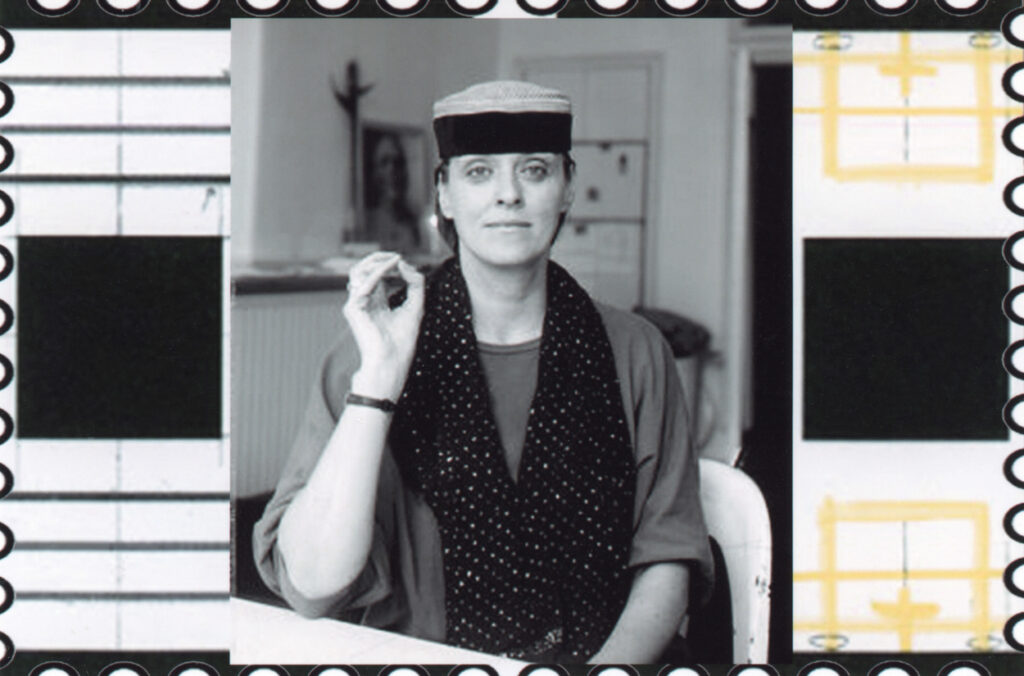
My name is Michelle Churchill. I was born and raised in St John’s, Newfoundland, and now reside in Mount Pearl. I have always been an artist in one form or another. From school as a teenager, I became fascinated with Black and White photography and learned how to develop my own film at the College of the North Atlantic. I graduated from Printing and then continued to graduate with a Graphic Design designation. As a young child my stepfather was an avid landscape painter, and my grandmother taught me how to quilt. My life was surrounded in fiddle playing, piano, voice lessons, and sessions of art classes at the Anna Templeton Centre.
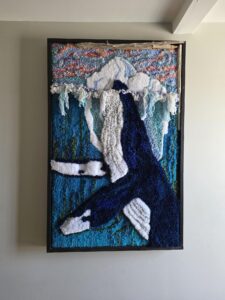
I first met fibre arts around 20 years ago. I am always curious about the next thing I can learn, and this was suggested by a friend of mine. I went and completed the night and realized I hated it. Being an artist with ADHD, I didn’t have the patience and found it quite difficult. Sometime later I had to have surgery and was housebound for six weeks. Out of pure boredom I tried it again and decided to do it my own way with my own style and found out, I was literally hooked on hooking (pun intended).
Can you tell us about your art practice? Your work includes landscapes, fashion – there’s a lot of reach. What leads you towards different projects?
My art practice is ever evolving. I am never satisfied and always fixated on my next project while still working on my current one. I tend to not just stay with one form of art expression. I go from felting to needle punching, to tufting, quilting, crochet, rug hooking, wool dyeing, 3d wool work and macrame. In my mind there is “always more” for me to learn. That is what being in artist is to me. Not just expression of my work but challenging myself and accomplishing things I once thought I could never do.
There is a benefit and curse of being an artist with ADHD. My mind races with 100 thoughts per second. Even as I am chatting with someone, at the same time my thoughts run like movie reels in constant motion that I can’t turn off. I am super-fixated on whatever I am doing and will spend weeks on a project. Getting up 3am if I have an idea or fix something I can’t stop thinking about. It’s like have lightning bolts of ideas that I can never get rid of. The benefits are in the results. I produce work that is colourful, full of humour, tracing stories out of pieces of wool about my beautiful home and the people in it.

My work has led me into directions I never thought It would go. I have won an award for my work with the Arts and Letters Competition; I have worked with many talented artists in collaborations for the Artist3 Stephenville Festival and with the ENGULFED wearable fashion show in Montreal and shown here at the Craft Council. My work hangs now in the new Mental Health Facility, and I have taught dozens of classes for the next generation of traditional and non-traditional hookers.
Is there one thing you wish people understood about fabric art?
There are no rules. Sure, there is a basic practice of how to create but I always have taught my students that once you learn technique, the rest is up to you. There is never a wrong way of doing things. Sometimes the best pieces I have created have started off as something else. There is no such thing as a mistake. Just a different way of doing something. Color outside the lines, don’t take yourself too seriously, and leave your mind open to possibilities.
Is there a particular artist or artwork, not necessarily in your field, that inspires you?
I am currently very interested in the woven master of wool and tapestries, Maximo Laura. He is a Peruvian is an award-winning tapestry weaver internationally recognized as one of South America’s pre-eminent and most unique textile artists. He is a consultant, designer and lecturer on art integration and synthesis of ancestral weaving techniques, symbols, memories, myths, and rituals with contemporary art. I resonate with his style and dedication to storytelling. His process closely resembles mine, yet his work as a tapestry weaver astounds me with his take on his culture and heritage. I am currently seeking funding to visit Peru and take part in his 10-day teaching residency. To be taught by a master Peruvian weaver is a once-in-a-lifetime opportunity.
What’s next for you?
Next for me, is always to do more and to experiment as much as possible. I am leaning towards much larger scale wall hangings now but also want to incorporate more functional pieces as well. Hopefully with the Peru residency, it will add to my ever-growing skills in design work, naturally dyeing techniques, weaving, and color theory. Of course, as I am typing this, I am already on my next second and third project simultaneously in my mind.