

Heads up cyber-trolls: Bridget Canning is Taking Down Names
September 2026
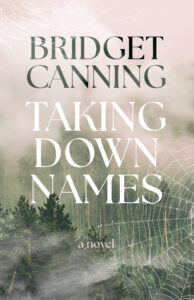
Congratulations on your new novel, Taking Down Names. I really liked how the title brings you right into the scene. Where did the tiat come from?
I find titles very hard. Originally, the book was supposed to be a film, and I had called it Water from Stones; the idea was trying to get remorse from somebody, like squeezing water from a stone. And I remember at the time people were like … Really? Uh, maybe that’s not really clear. Then there was just something about [character] names. I love names, and then there’s something about naming the victims, naming the oppressors, naming the bullies, and taking down something. And also the whole act of revenge.
It immediately set the tone, it immediately set the scene, and it immediately prepared us to meet someone who was in the kind of mental space that you central character, Jacky Careen, is in. And I really loved how her surname was also a verb. That very much underscores the, I don’t even want to say arc of her life, the kind of waywardness of her life. But you said you first set out to write a film?
It was going to be a film. Originally, I’m trying to think, this was 2017, I think. Elizabeth de Mariaffi had won this contest called From Our Dark Side, and it’s a film incubator project out of Vancouver. It was run by the Vancouver Women Film Festival. And it was an initiative to get more women involved in writing genre films. Because women are huge consumers of genre, like mystery, horror, stuff like that. But not huge writers of it, of just getting into that industry. It’s more monopolized by men. So what you had to do was submit a synopsis for a film. And I thought there was a horror movie where it was a serial killer who murders Internet trolls. So I submitted a synopsis, and I won. So that was great. It was five winners across Canada, and they flew me up to Vancouver, and we did this whole film incubator project, and they taught us the art of pitching, and all these things, and they sent us to Frontiéres Market in Montreal, and I pitched it in Montreal. And it went well. I got interest, Vice magazine did a little article saying it was one of the best pitches of the festival. So I was like, here we go. Hollywood now. But I kind of went around with a few producers and it just never happened. So then I thought, well, if it’s not going to be a film right now, but the story was still in my mind. I was so fixated. Well, I’ll write a novel, and when you focus on it being a novel, it can be whatever you want. Whereas when it’s a film, you are kind of like, okay, here’s our budget. And there was some [pressure to] make it like a neutral place. that could be anywhere. But a novel, I can make it here. Setting is so important. So I was excited to write it as a story that takes place in Newfoundland.
What was your original starting point?
I had an idea that the main character, her name was Jacky as well, Jacky was also the victim of revenge porn, or cybersexual violence – I try to say cybersexual violence, instead of revenge porn, because ‘revenge’ suggests that someone’s actually done something [bad]. She was studying statistics, so she had a very keen mind, and she had won all these scholarships and was in a prestigious school, in a very competitive academic environment, and she gets involved with this boyfriend, and it doesn’t work out, she breaks up with him, and he does this to her. And she loses her internship. It really affects her image. In the film idea, she had basically started over in a smaller town at a different institute. She’s actually changed her name because she’s just been harassed so much. She’s in this very dark place, in the film version, and she gets involved with a professor, studying cybebullying. So the film idea was different in that the Jacky was also the victim. But when I started writing this book, I thought, it’s got to be someone close to her. Especially with siblings, I think that’s very kind of primal. Like, how dare you do that to my sister? And Jacky also needed to be very involved in her community and very aware of everything.
What about the decision to have, I believe it ends up being five points of view, all female?
When I was thinking of it as a film, it was going to be from one point of view, but I had a whole bunch of ideas for scenes for people finding bodies. And I also had ideas for people discussing it, [introducing] red herrings and all these different characters. So I already had a pretty good idea that there was going to be lots of interesting characters. But when I decided that it was going to be set here, and when I decided it made sense for Jacky to be a journalist – also at the time there was so much going on. When I started writing this as a book, it was getting close to 2019, and COVID and everything was happening. And there was just so much hostility towards journalists that I decided, she’s a journalist. She is going to be someone who’s being maligned. So who is she going to be interacting with? There’s probably going to be someone who’s a budding politician. And I didn’t want it to be too St John’s-centric. Rondonna, who finds the body, has her story. Lovetta, the budding politician, has her story. And I like doing that a lot. Whenever I’m writing something, I never want there to be just one-sided characters. For me, it’s all about empathy.
Talking about Jacky being a journalist, I noticed in your notes you mentioned how important it was for that to be very authentic. You interviewed working female journalists.
I am very lucky that my aunt is Diane Humber. And her son, Jacob, he did his Master’s of Science on occupational issues with journalists. So he gave me his thesis, and I sat down and read it, it was fascinating, and very, very helpful. I also talked to Tara Hartley. I talked to Gerri-Lynn Mackey.. The moment where Jacky is chased off by a guy with a golf club, I’ve heard a story something similar to that. It wasn’t a golf club, but it was pretty bad.
What about how Jacky tracks people online, did you know how to do that?
I’m actually pretty good at it. We think, Oh, it’s the worldwide web, it’s so huge. But, if you know it’s somebody local you can kind of figure out, through friends and social media, who they are. But I did watch a bunch of different documentaries about people who are troll hunters, tracking down bullies, and what they do. I read a number of articles about going through someone’s profile, and their posts, looking for clues.
I was really struck by this idea of how porous the world was. There was just no privacy, sanctuary, at all.
Lately, one of the things that concerns me with social media is just the shaming. If you get arrested for something, you’re going to be on one of these Facebook pages, local criminals, skeet-of-the-week kind of stuff. And you’re ripped to shreds. Especially right now where there’s so much poverty and addiction going on, it’s poverty shaming, addiction shaming. And this is rampant. So for Jackie, she would just be seeing that everywhere. Because it is everywhere.
I’ve been calling this book a thriller. And there is a point where it really takes a turn.
I think there’s something about the idea of vengeance and wanting … anger is a choice. When we’re feeling sad and we’re grieving, there’s not much we can do, we have to sit with it. But anger is really very helpful in many ways for getting over things. Choosing to act on your anger and choosing to do little vengeful things and payback and stuff like that is a choice, it’s an empowering idea to have flow through you. For Jacky. It’s still about [her younger sister] Mia. It’s all about Mia, Jacky’s loss of her sister.
At a certain point the story goes to a really violent place. Did you know that that was going to happen?
I knew who the culprit was. I was quite worried that it was obvious. I was thinking a lot about people who go on, like, 4chan, or incels, and you are alone in your basement, and you are watching things online. And maybe you don’t have someone right in front of you who are talking about this face-to-face, but you’re empowered by this fact that you can go online and do that. And maybe find someone agreeing with you. There is something about villains who care about each other.
I really liked your metaphor for grief, that it was like a game of Pass the Parcel. What was that like for you to write about someone that was so steeped in that kind of loss?
I’ve had lots of loss in my life. When someone dies by suicide, you don’t really know what to do with that grief. You know, I lost my father to cancer. You can get really mad at cancer. You get really mad at your DNA. Stuff like this. But, especially after something that’s so traumatic, what do you do with your grief? It feels like you’ve been handed this package: unwrap it, deal with it. Think about it constantly, analyze it. peel off the layers. When you have a violent death or a complicated death, that’s unfair. How on earth do you unpack that? I’ve lost two people close to me to suicide, you want to say it’s mental illness and stuff like that, but also, you can’t help question who aggravated, heightened their struggles.
My last question is one I’ve asked you before, but I’m going to ask you again –
Why do I give my characters such a hard time? … I don’t think their struggles are completely out of the blue. I mean, we go through hard times. Sometimes, I do feel like, God, am I torturing them? But I think when you’re in a bad place, everything shines a lot brighter, and so when you’re in that kind of headspace, when you’re grieving, everything is work. Where Jacky is, everything is work. Socializing is work. And, well, what does anyone want to read about? Like everything worked out great, we all went home? So it seems like maybe I’m piling on them, but hopefully it doesn’t come across like … some vengeful god or something.
Do you always know how the characters are going to react?
No, I don’t. I really don’t. In a lot of things I’ve written, I think I know what’s happening, and then when I’m writing, I think, oh, no, they wouldn’t do that. Nope, they wouldn’t do that at all. When I’m writing a character, I’ll write, and then I step back and I’ll do things like, I’ll make a playlist of what songs I think they like. And I’ll walk around and I’ll just listen to it for a while. And then when I go back to writing, it’s kind of like they’re telling me themselves.
Is there anything, I haven’t asked you about the book that you like to talk about?
I really liked writing about how different characters felt about community in Newfoundland. And it was important for me that Jacky, Lovetta, Rondonna, Ashleigh, Theresa, they all have different ideas about this place. It was important for me for they all can’t help but be madly in love with this place. One of the most powerful things that connects everyone is this idea of community and home. It was very important for me for Lovetta to be – she’s not a politician because she, I’m sure she’s ambitious and stuff like that, but because she feels very passionate, she loves this place. And I love Newfoundland, so writing allows me to express the spectrum of feelings that I have. I really enjoyed that.
Can I ask what you’re working on now?
I have been working on … I’ve been trying … This is what I end up doing. I start writing something really long and hard, and then I get to a point where it’s really difficult, and then when I try to focus on finishing it, I start something new. So I ended up this summer, I was trying to finish another manuscript for a novel that I started years ago. I ended up writing a short story. And I ended up working on a novella. And I ended up writing a script for a short film. But yeah, so I have a short story. I have a novella I need to finish, and I have a novel I need to finish. And I have a short film that hopefully will come to fruition at some point.
Taking Down Names is published by Breakwater.