

The Dog, The Dress & Memorial
February 2026
By Eva Crocker
It’s damp early spring and my across-the-hall neighbour, Michael, is stacking smashed car windshields in the hall outside his unit. Michael collects cracked windshields from garages, and then pounds them until they become a constellation of shards, held together by the special coating designed to allow glass to shatter while staying in one piece. Michael is a sculptor who’s been renting the loft across the hall from me as an artist studio for eight years. Rent has finally become too expensive, so today he’s beginning the project of clearing out his space.
Sitting on a chair in the hall across from Michael’s open door tying my sneakers, I notice a white lap-dog in the center of the studio. Its head is tilted to the side, ears perked, eyes gleaming. It’s staring at me in a trance of small-dog anxious intensity, belly to the ground, paws stretched out in front. I’m expecting a shrill bark at any moment. But something is off.
When Michael emerges from out of view with the gutted plywood casing of a set of speakers, I say, “I was just looking at your little dog. But … he’s not real, is he?”
“I have a great story about that dog,” Michael answers.
It turns out the dog is real, it’s just not alive. Michael tells me he went to a taxidermist looking for a cat for an installation. The guy behind the counter opened a deep freeze and fished out a vacuum sealed bag with a flattened cat inside. Someone had found it run-over in the street and left it with the taxidermist, who cleaned and froze it. In case someone like Michael should wander in, looking for a cat.
“I couldn’t afford it though,” Michael said. “On my way out, I noticed this guy, on a shelf by the door.”
It turned out the dog was going cheap, the old lady who brought him in had paid half upfront but died before she could bring him home.
“He’s been with me for years.” Michael said, “My students love him.”
***
It was still deep dark winter in Montreal when I went to see a retrospective of Jana Sterbak’s work titled Corpus Insolite at the Musée des Hospitalières, curated by my PhD supervisor, Dr Johanne Sloane. The museum is dedicated to the history of the convent and hospital which houses it, founded by the Hospitalières of Saint Joseph, a group of Catholic nuns, in 1961.
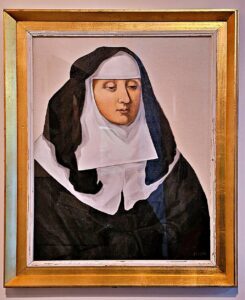
The museum’s permanent collection showcases historical medical equipment alongside examples of the nuns’ religious arts practices. In one room, a ceramic vessel for leeches is mounted across from a case with cloth masks that would be doused with ether for anesthetization. There are shiny forceps and a needle so large it looks almost cartoonish. On the floor below, Catholic relics are arranged in glass cases. Each relic is about the size of a bottle cap and contains a scrap of human tissue, bone, or hair surrounded by intricate beading and embroidery enclosed within a broach-like case. These decorative pieces are part of a Catholic tradition, which includes preserving a piece of the venerated body of a saint or holy person. Small relics, like the ones described above, were made to be worn by their owners. The intimate proximity is meant to offer protection, solace, healing, and perhaps to allow a little holiness to literally rub off on the wearer.
In an alcove off the stairs, in a glass coffin decorated with gold fringe a to-scale wax sculpture of Saint Félix* lies on a red velvet cushion. The figure’s head is tilted back, glass eyes rolled in agony or ecstasy, mouth open to show two neat rows of teeth. There are red wounds on the figure’s arms and legs; a plaque beside the mannequin explains that pieces of the real saint’s body (which are not visible to the naked eye) were inserted into these gashes.
This exhibition marks the first time the museum has hosted contemporary art. Sloan’s decision to embed Sterbak’s works within the museum’s permanent collection highlights the themes of embodiment, mortality, and gender that suffuse the venue and the art work.
The exhibition included Perspiration: Olfactory Portrait, a bulbous glass sculpture with chemically reconstituted human sweat inside; there is a photograph of a work stored at the Musée d’art contemporain de Montréal, Untitled (For Terry Last) a fountain pen filled with HIV-positive blood; and Chemise de Nuit (1993) a translucent nightdress with human chest hair sewn into the front; a version of Sterbak’s controversial piece, Vanitas: Flesh Dress for an Albino Anorectic (first displayed in 1987). The original Flesh Dress, as well as its more recent incarnations, is a dress sewn from pieces of raw flank steak. On the opening night of the exhibition, the dress sweats beneath the museum lights, slowly beginning to cure itself. On the wall adjacent to the installation, there is a photograph of Sterbak wearing the original meat dress, a flouncier number. In the photograph the dress is bright red against a notably white backdrop. In the catalogue for the exhibition Sloan explains that the white cube approach to displaying contemporary art “… provides an austere space of blank walls in which nothing is supposed to intrude on the viewer’s experience of the art.” However, for this exhibition, Sloan and Sterbak wanted to play with the unexpected connections created by putting the works in conversation with the devotional and medical objects in the museum.
***
The coincidence of being greeted by a taxidermized puppy shortly after wandering between a flesh dress and ornately embellished pieces of preserved human heart catapulted me back to my first semester at Memorial University of Newfoundland, more than 15 years ago.

That fall, I took an intro to the history of medicine and a gender studies course on “the body” with Dr Sonja Boon. Both courses focused on how our perception of the human body is socially constructed, how ideas about the body as sacred or private are constantly evolving. In Boon’s course, we read Katherine Liepe-Levison’s “Striptease: Desire, Mimetic Jeopardy and Performing Spectators,” an essay about how power dynamics subtly shift between dancers and patrons during the rituals performed at the strip club. As well as, Meyda Yegenoglu’s “Veiled Fantasies: Cultural and Sexual Difference in the Discourse of Orientalism,” a paper about the Orientalism implicit in the West’s framing of the hijab as anti-feminist – feeling very relevant as I study in Quebec where they are currently trying to extend their Islamophobic anti-religious symbols bill to ban women and girls from wearing head coverings in schools. We read Donna Haraway’s “Cyborg Manifesto,” about the fallacy of believing there is any such thing as a pure human body unaltered by technology – she proves her point, in part, by asking whether wearing glasses makes us a cyborg? And Julia Kristeva’s “The Powers of Horror,” on the corpse as abject, a body we’re simultaneously drawn to and disgusted by because it is both human and not, reminding us of our own mortality.
In “History of Medicine,” we read a textbook of essays that covered topics like: how the advent of plastics influenced the development of prosthetic limbs, and how the inception of pediatrics is linked to nationalism. The chapter that captivated me was on the history of dissection in the West. It explained that the practice of cutting open dead bodies to learn about their insides had gone in and out of fashion; at times immoral and forbidden, at times acceptable if performed on certain types of bodies (deceased prisoners and “foreigners” primarily). Most of the early dissections in the West were performed by doctors on deceased men. However, in the 1500s in Italy, dissections were also taking place in convents; nuns lovingly dissected other nuns in order to create relics, similar to the ones I saw alongside Sterbak’s work at Musée des Hospitalières.
If there was something unsettling about Michael’s mop dog it was how, also preserved out of love and then transformed into art, it now inhabited that eerie middle ground between living thing and object. Like Sterbak’s sculptures which incorporate pieces of human bodies, or her meat dress which viscerally evokes the impermanence of our physical form, the relics and the dog force us to consider how much of our essence is bound-up in our physical self. These encounters with bodies-turned-art-object stirred up all those questions I’d first thought about in the basement of the science building at Memorial.
At the center of the texts I studied at Memorial, which flooded back to me in the convent during Steback’s opening, was an investigation of the fluidity of our ideas about morality and the body. They each articulate their own overlapping questions about what it means to find ourselves briefly within a body, within a society.
*Editor’s Note – Felix is the patron saint of lost animals & spiders.