“Is the journey finished? Absolutely not.” Brad Gushue on his new memoir
November 2026
Brad Gushue was part of Canada’s first ever Olympic gold medal-winning team in men’s curling at Turin 2006. Sixteen years later, he returned to Olympic ice at Beijing 2022 and won a bronze medal. Gushue has also won four Brier titles — tied for the most all-time by a skip — as well as a gold and two silver medals at the world championships.
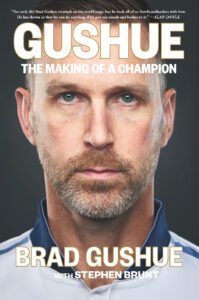
Gushue retired from curling after the Montana’s Brier in St John’s in March 2026, and has now released Gushue: The Making of a Champion, co-written with Stephen Brunt (sports journalist and co-founder of Writers at Woody Point).
Can we start by talking about your collaboration with Stephen?
The process with Stephen was an interview process, so we spent a lot of time just chatting with each other. He would come back if there were some questions afterwards, if he wanted to fill in. some information. And you’ll notice in the book that different chapters are in two different fonts, and one of the fonts is me just kind of making a diary entry going through the last year. Those are really almost taken verbatim and sharing with the reader what I was experiencing in those moments. But the rest of it was very conversational. I think one thing Stephen’s really good at, one of the reasons why I wanted him to be part of this process, is he’s a very good interviewer and he’s very willing to dig deeper, and I’ve heard him ask me many times, tell me more about a certain situation. And I thought he was able to draw more out of me than probably initially I was thinking I would share and I think that made for a much better product.
How long did that take? The book feels very timely.
Yeah, it wasn’t short. I think it was short by book standards, but for my standards, it still took a long time. We started to have the conversation, Stephen and I, back in June of 2025. And when we had those conversations, we were able to sign on with Penguin Random House fairly quickly after that. And then we started to do the interview process and the writing process in September of 2025. We got a lot of it done before the season started, and then as the season started, we had regular check-ins throughout the year, and I was getting copies of what we were working through and we were making some changes, adding some stories, taking some out. After The Briar was done, after my season was done, we got the final copy, and then we had a pretty short period from that point on to get everything cleaned up and edited, and by, I think it was end of May, it was submitted, and there were no changes after that.
Did you keep diaries during your career?
I didn’t. I’ve got a pretty good memory, and one of the great things about this process too, for me, was I felt like it was a somewhat therapeutic process. Stephen and I would have a conversation about a certain event or something that happened, and during the season, I could go back and talk to my teammates about it and say, we’re discussing the 2017 Brier, for example. And I would share some of the stories that I remember, and then Mark [Nichols] was able to jump in, and Geoff [Walker] was able to jump in, and share what they went through, and it added layers to my story because some of the things I had forgotten, but I was able to then call up Stephen and share those moments.
You mentioned how this was therapeutic. I was wondering how it’s helping you with the decision that you’ve made to step down from this career.
Yeah, it’s helped. This whole process that I went through in my last year was difficult. I think the retirement was difficult, but I think writing the book and going through this process made me realize I am comfortable in this decision. It is the right decision for me. It doesn’t mean it’s been an easy decision or an easy process because I’ve been in love with the game for the last 30 years and devoted my heart and soul to it. Stepping away, it feels like there’s a big chasm left. So I know that that’s still a journey that I need to go through, but the ability to talk about it and to share some of the high points and some of the low points in my career, it’s made that process easier and sometimes just sharing what you’re going through, what you’ve been through, what you experienced, can help. And for me this process has helped and now people are going to know everything that happened behind the scenes. I think for the fans and supporters that we had over the years, they’ve seen what happened on TV, but they oftentimes didn’t see what was leading into that, some of the things we were able to overcome and some of the bad decisions or mistakes that we made leading into some of those events. I think it’s going to be good for our supporters. It was certainly good for me to go through this process, and even my family, like my wife was a big part of this process, and she encouraged me quite strongly to make sure that I was open and honest, and made myself vulnerable during this process. I think I did that and I think Stephen helped me do that.
The description of the games, of course, are very exciting, but I really liked your emphasis, too, on the mental preparation for it. You were one of the first teams to involve a sports psychologist, and you were literally laughed at for that.
Yes.
But you had that awareness that was a very important tool to also have in your kit.
We were, at times throughout our career, ahead of the curve, and the sports psychology side was one of those areas that we were one of the first teams, if not the first team, to have a sports psychologist that we worked with on a regular basis. And I think that’s part of the reason why we had that early success that we had at the 2006 Olympics. I think we fast-forwarded some of the learning curve that a lot of teams had to go through to get to that level, with the exercises and the work that we put in mentally. I think we were mature on the ice for our age. You know, we weren’t that mature off, but on the ice we brought a level of maturity. It definitely helped get us to that level quicker. And It also paid a lot of dividends once we got later in our career and started dealing with more pressure. At the end of my career, with all the skills that I developed over the previous 25 years, I don’t think I did a great job of handling things mentally. I think I let the pressure and the expectations get to me a little bit, and I share that in the book, that I felt the pressure. For the amount of experience and the amount of work that I did on the mental side, I should have been better at that, but I think it just shows the complexity of the mind and the challenges we all face as we age and face different circumstances. It really has been eye-opening for me and interesting for me to go through that process.
I was really struck by your comment that when you are as good at something, like as good as you were at curling, it means your life is actually out of balance. Can you expand on that a little?
I think if you aspire to be the best in the world or the best in your field, there’s an almost 100% certainty that your life has to get out of balance. What I mean by that is, there’s certain things that you’re going to have to sacrifice because you’re going to have to spend more time at your trade or at your craft. For me, social activities definitely took a hit. I didn’t get to go out with my friends or party with my friends as much as possible. I missed a ton of birthdays and anniversaries and other celebrations that our family and friends had. There’s a number of other things that I’ve sacrificed to be the best in the world. I don’t regret a lot of those sacrifices because it brought me so much on the other side. Our successes have allowed us to do things that most people don’t get to do. So I’m not complaining about it. I’m just expressing that, people that want to aspire to get to where we are, you have to be willing to sacrifice and know that things aren’t going to be as balanced. Your work life balance is not going to be the same because you’re going to have to devote more to the work side. And I think that’s pretty typical for anybody that excels in whatever they do.
I thought it was so self-aware, and I wondered, do you remember how young you were when you realized that?
I think I realized it more later in my career. When I started to have kids. That made me certainly more aware of the balance because then I felt like I was missing more. But the reason why I could justify it in my mind was, one, I was chasing my dreams, which I think is important for anybody. But I was also able to provide for my family, it was my profession. But, to do that, you’ve got to be committed, and that’s why when I went on the road. I took it very seriously. I didn’t party. I didn’t stay up all night. I made sure when we got to a game that I was as ready as I could be to go out and compete because I knew I was sacrificing so much at home. And that realization definitely came when I had kids. Before that, I didn’t think about it because my only focus was curling, that was my North Star, and everything that I worked towards was curling, and to be honest, it was that way up until I retired. Every movement or every decision I made, I thought about curling behind it. So the self-awareness wasn’t necessarily there in my 20s, but I think as I got older, and my kids got older, that self-awareness became more prominent.
What kind of message would you like readers to take from your book?
That I’m not perfect. I’ve made a lot of mistakes. I shared some of the ways that I had to evolve and some of the things that I probably didn’t handle as well as I should. And also that we had some struggles and challenges that people weren’t aware of, that made some of our successes even more special. I did interviews after some of those wins where I talked about it being special, but nobody ever knew why. I wanted to share some of those reasons why, and it’s not all butterflies and roses. There’s some messy stuff that happens when you try to get be the best in the world, and I wasn’t particularly the best teammate, I wasn’t the best leader, early on in my career, and I had to change and evolve, and I had to be aware of what I was doing. Is the journey finished? Absolutely not. I still need to learn and evolve and improve, but it has been a journey for me and I wanted to share that journey.
You also bring us into a space few people would be in, to be at the top, to be the best, and then to know it was time to leave. That’s not something a lot of people actually get to experience.
Yeah, and that was part of this book, that last year and the change from being the best in the world at something for a decade, to walk away when you’re still one of the best in the world. And then jump into whatever it is I’m going to end up doing for the next chapter of my life. I just felt this level of stress and anxiety that, I can’t be the only one that’s experiencing that when they’re in their mid-40s and looking at a career change, and sharing what I was going through and those mental struggles. It’s important because I know there’s other people out there that are experiencing it and just not talking about it, but, for me, it was good to get it out there because it has been a journey and a battle and it continues to be a journey and a battle. What is my new North Star? What is it that I’m going to be passionate about and committed to, the same way that I was for curling? Now, the reality is, probably, I’m never going to find something to that level, but I need to find something that at least gets me close.
Gushue: The Making of a Champion is published by Penguin Random House Canada.
Author photo: Sophie Hefferton