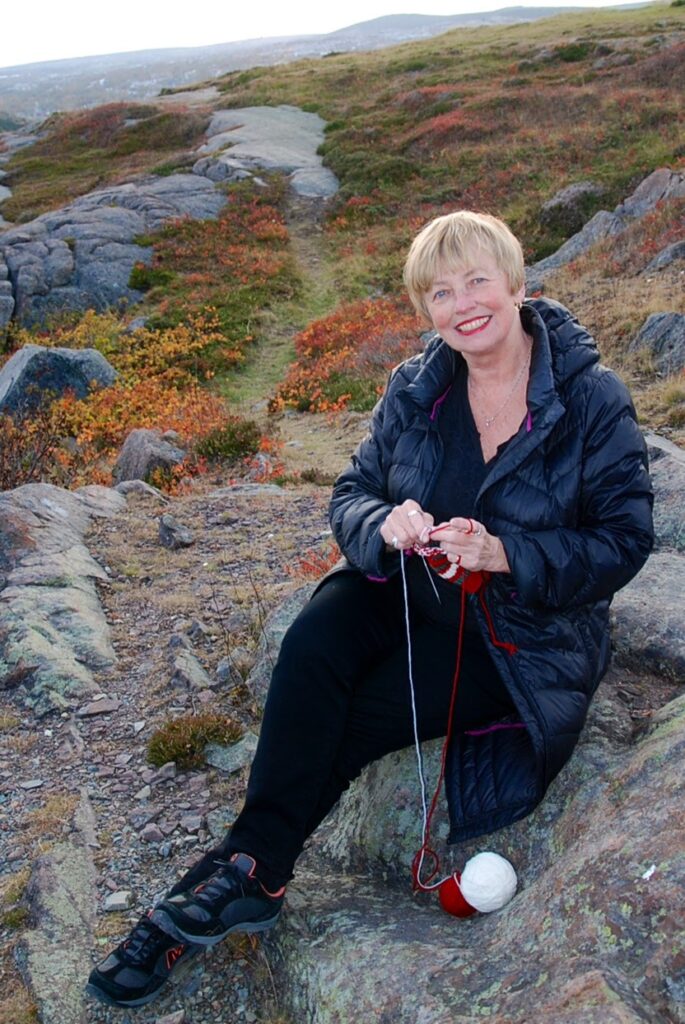


“Resist, resist, resist. No gesture is too small”: Carol Off on the new American threat
October 2026
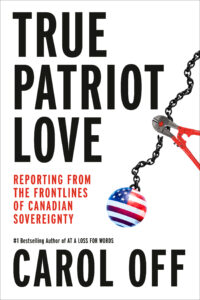
“From the #1 bestselling author of At a Loss for Words, comes a passionate and sweeping examination of who we are as Canadians, where we’re going, and why Canada is becoming a beacon of hope in an age of cynicism.
Since she stepped down from CBC’s As It Happens, Carol Off has been on the road talking to Canadians about their country and listening to their questions about its future. With True Patriot Love, she’s ready to offer answers, drawing on lessons from the crises of the past 60 years that have prepared Canadians to seize the current moment and become a mature country.
Off has witnessed nation-defining events during her lifetime, from the first unfurling of the Canadian flag to the explosion of cultural nationalism in the 1970s. As a journalist she covered the Canada-US Free Trade Agreement; Quebec sovereignty politics; Western alienation; the country’s fraught relationship with Indigenous Peoples; and Canadian military missions around the world.
In True Patriot Love, Off takes us on a journey through that history, weaving it with personal experiences.” – penguinrandomhouse.ca
I’d like to start by asking about the way that you blend in biographical details. I thought it provided so much balance and illumination. What kind of decisions did you make about what you were going to include from your own life?
Because I’m a journalist, it’s really, really hard to break that wall and to talk about oneself – do you even have opinions? So after you’ve spent decades doing that, trying to be invisible, and keeping the story front and centre, but I got a good practice doing At A Loss For Words, because in that book, I was describing what we stood to lose with [US President] Donald Trump, and I was describing things through my own lens, and I began to talk about myself, my own reflections and experiences. And it worked, and so I thought, okay, well maybe I can open that up a bit more. I just found, ultimately, the only way I could describe and talk about patriotism and Canada was to be the Canadian that I’m writing about, to be that person who’s discovering her country for the first time and finding that it is quite a wonderful place to live.
You share details of your working life as a journalist, and don’t glamorize it at all. Sometimes you were chasing after premiers during the Meech Lake negotiations and all that kind of foolish stuff. And there was the sexism of that time of Prime Minister Brian Mulroney’s era in Ottawa.
And I write about the sexism, and I specifically talk about sexual assault, which I had suffered, but not as egregiously as some of my colleagues. What was happening to women at that time, and apparently I’m told, still goes on to some extent, because places of power often think that they can do whatever they want. But I think why I put that in, why I included that kind of toxic masculinity we now call it, is in describing the 1980s when we were seeing the free trade agreement signed and the Meech Lake Accord being negotiated, was that this is the kind of male dominated world that was making those decisions and they didn’t think they had to consult anybody. Not least of all, women or Indigenous people or anybody in other territories. And so, there was this kind of attitude that they knew best, and they could make decisions about the entire country as a group of white men behind closed doors, having meetings in secret, and then presenting a fait accompli to the rest of the country. I found that that attitude of male power and entitlement, I physically and personally was affected by it, and it became the lens through which I started to watch what was going on in this country and to cover it, realizing how much of it came through that prism of power.
Did you perceive it that way at the time, as a young woman in the 1980s, or did it come to you looking back?
Ah, that’s a really good question. I think I started to see it mostly in retrospect, but some at the time, because I covered it from that point of view. I was appalled by how I was treated as a woman. I had just travelled, hitchhiked across the country. I had seen the Charter of Rights and Freedoms allow for women to have rights. I had been part of the women’s movement on campus at university. So I’d come with all of this experiences as a young woman and arrived in this place where I could have travelled by time machine because Ottawa in 1980 was something out of another era, more like what my mother described of her workplace. I realized that I had gone back in time and that this was a backwater from a point of view of morals and ethics. And I think I largely understood that at the time and I was just offended by it. That offence festered and grew in me, and finally I was able, as a mature woman, who had put all that behind her, to look back and say, yeah, I guess that’s why I thought about it and wrote about it as I did at that time.
You have many, I’m thinking ‘building blocks’, perhaps it’s not quite the right term – Meech Lake, and the adoption of the new Canadian flag, and Canadian forces in Bosnia and Rwanda – you have very specific events that you revisit and build on. How did you choose those?
They were the ones that made the strongest impression on me, but from the point of view of the arc of the story, they were the ones that I thought that really represented how the country was developing and growing and coming into its own. And I thought that the arc kind of bends from my experience as a kid, watching the Canadian flag go up the pole for the first time, and that arc bends to my time in Afghanistan with Canadian soldiers. And seeing what Canada has become on the world stage. And then covering international events that Canada was involved in. So, the events that I chose, those blocks, and I think blocks is the right word, those were the chunks of time when I had the most experience, but also the chunks of time where I see them connected together, building toward a time when we were threatened by the United States. I don’t think we would have been in the same place 20 years ago, 30 years ago, 40 years ago, [in terms of responding] to the way Donald Trump is attempting to overcome us now. We might have succumbed. We did during the free trade negotiations, didn’t we? Because we just wanted cheaper vegetables, and we didn’t really understand how much we stood to lose, because we were such a young country. We were not ready for it, but now we are, in this really strong way. So I wanted to show that arc from a time when we weren’t even sure we should have our own flag, to a time when we feel we have a place on the world stage and we want to hold it.
I’m struck by how timely the book is – there’s a such a constant barrage of headlines but this text hasn’t been overtaken at all.
A lot of it was, I was doing this job for so many years where you have to start to figure out, where’s the puck going? And you skate to where the puck’s going, not to where it’s been. I could see where this is headed, because I’ve been in this movie so many times before. But there are so many things I just never could have anticipated. I didn’t anticipate that [Prime Minister] Mark Carney would walk away from that deal that Friday night in August, that he would say, no, no, can’t do it. The book was already headed to the printer’s by then, [but I was thinking] at some point he’ll cave. He’ll give in the way the others have on Canadian culture and they won’t think it is important. And yet, bang, he turned around and something snapped in him. or the people who are advising him, to say, no, we stand to lose so much more than steel and shingles or oil revenues. If we don’t have a sovereign culture, we don’t have a sovereign country.
I know it’s very early days with publicity for the book, but what kind of reaction is it getting?
We’re [talking] so early the book isn’t even out at this point. When I try, I have a hard time explaining it, because I say to people, well, I have a book coming out and they say, well, what’s it about? And I look at them blankly, and I say, it’s called True Patriot Love. And they say, well, okay, but what’s it about? Well, this about Canada. Okay. And I say, well, it’s about many things. I’m really happy to have early interviews like this one with someone who’s going to ask me questions and I’m thinking about what this book’s about. So my first reaction from people is just them being perplexed as to what on earth I’m doing [laughs].
Well, I think one of the things you’re onto is your way of saying there are things that we have to be uncomfortable about. So much current US policy is driven by the thought that certain groups of people must never be made uncomfortable. But we do make mistakes, and they should be acknowledged.
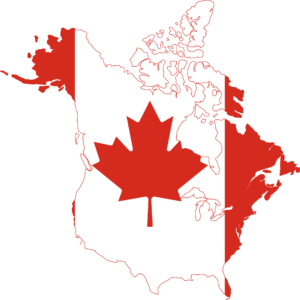
I think that that’s really one of the most important qualities of being a Canadian, that there’s a tremendous tolerance for contradiction. That we can hold contradictory ideas in our heads at the same time. And we have to, because the country is just a bundle of contradictions. And so if we can’t embrace contradiction, if we say it has to be this or that, then we can’t survive. I think that’s where United States is failing because it keeps trying to force things into a mould that works perfectly with its self-mythology. Whereas we accept, we have to accept, that {Canada’s first Prime Minister] John A Macdonald did something quite extraordinary in building the country as it was at that time, but also he did so on the backs of the Indigenous people who lived here and attempted to destroy those people. I mean, those things are true. And so, if we can come to the point where we can pull these things together in our minds, and in our history, which I think is close to impossible, but that gives us a strength that few other countries have, that we would embrace contradiction, and we don’t take our symbols as saying its just this or that. Our flag represents so many things.
If there was one action you would like people to take after reading your book, what would it be?
Resist, resist, resist. And by resisting, it can be so many things. No gesture is too small. We may be called upon to do things in a very large, even military way to resist and to defend. It may be that we’re going to have to suffer from hardship in order to resist and to hold on to our sovereignty. But it may be in the smallest things where you’re not afraid to seek the truth. You’re not afraid to answer to things. You’re not afraid to tell your kids what’s going on. You’re not afraid to speak up against injustice. And one most important qualities of Canada that I really, really worry about the most is that we will lose our multi-ethnic heritage and our appreciation of being an open country. There’s no such thing as an ethnic Canadian. It’s a civic space. We’re kind an idea. It’s not an identity. And I really worry when I watch what’s happening both in Quebec and Alberta, where I’m seeing a nationalism that’s really very ethnically based. The most important thing is that we have to recognize that. And to stand up against those who would say, well, I have nothing against immigrants, but, you know, there’s too many. Just be open to the outside world, and to accept and defend those who are LGBTQ or defend the rights of Indigenous people to make their legitimate claims on their land and territory, defend all that. But in the most simple way, just speak up when somebody says something bigoted.
Any predictions of what’s going to happen over the fall, over the next year or so?
Journalists do their best work when they say what’s happened and their worst work when they say what’s going to happen. But that’s never stopped us … I think that it’s going to be rough. I think we’re going to have to really hold on to the idea that Mark Carney is the right guy at the right time and hope that he pulls us through this. But I think that there’s no going back. I mean, we’ve seen it. One day we will thank Donald Trump for waking us up because we were in a kind of slumber, and we are now aware of the threats to us. I think a really significant things is that maybe some of these barriers between provinces will start to come down. I’m looking at Churchill Falls when I say that, that maybe it’s now possible for us to start seeing how we have to cooperate between provinces. We are going to have to start breaking down those barriers and working together as a country. So, if anything comes of this, I hope it’s that we start rallying ourselves as, not a people, but as an idea that we all share.
Those are the questions that I had. Is there anything that I haven’t asked you about the book that you’d like to talk about?
[pause] For me, this book is really a kind of love letter to Canada. And it’s my love letter to Canada, but it’s also a cautionary tale – we could lose it so quickly, and not just because Donald Trump is threatening us, but because if we don’t hold on to and protect what’s the most valuable and the most important about this idea of Canada, and if we lose sight of that, if we start to become narrow-minded, and nationalistic instead of patriotic, then we will lose what’s so special about this place.
True Patriot Love: Reporting From the Front Lones of Canadian Sovereignty is published by Pengiun RandomHouse.