

“You have to love your characters—even the villains”: Michel Jean
October 2026
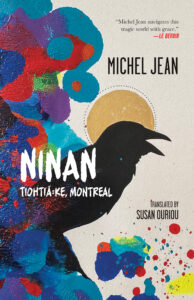
Released from prison after ten years spent behind bars for the murder of his violent, alcoholic father, Élie Mestenapeo finds himself out in the world again, but alone. Banished for life from his community, Nutashkuan, he heads south to Montreal, where he becomes part of a new community—Cree, Nakota, Inuit, Innu, Mohawk, and Atikamekw come together in Cabot Square. There, Élie meets Mary and Tracy, Inuuk twin sisters who take him under their wing; Jimmy, a Nakota man who hands out hot meals to those the city has forgotten; and Mafia Doc, an aging, self-proclaimed nurse who refuses to abandon his tent even as winter’s brutal cold descends. When old wounds threaten to reopen, Élie’s loved ones worry what a search for truth might do to him and the community around him.
“ … a humane and wonderful novel.” – Literary Review of Canada
Michel Jean is a writer, news anchor, host and investigative reporter from the community of Mashteuiatsh, Quebec. Jean uses his works to make his readers aware of Indigenous issues. Through his books, he deals sensitively with complex and sometimes painful issues in a way that has touched thousands of readers. He is also recognized for the important role he has played in the journalistic field.
This interview was conducted by email.
Can you talk a little about the process of translation? Were there unexpected hitches, such as words or phrases that were not translatable?
The work of translators is essential, crucial. I entrust my work to them. It’s not just about translating words. You have to translate the meaning and respect the atmosphere. I often write using a spare style, seeking to create images in the mind of the reader because I aim to establish a connection with the world and culture of Indigenous peoples. This is a challenge for the translator because when there are fewer words, each one must convey more meaning, and each must be chosen with care.
Translators don’t hesitate to ask me for clarification or to explain the meaning of an expression or a sentence—especially when it comes to Indigenous culture. They want to be sure they’ve understood correctly, and I believe the best translators are the ones who ask the most questions.
That said, in most cases, I can’t judge the work that’s been done because I don’t understand the language. You have to trust the translator—and, above all, the publisher. That’s why I choose the publishers I work with very carefully. I have to like their work; we have to be part of the same literary family. Writing is a solitary endeavor. Making a book is a team effort.
The way you consistently cite place names from different languages creates layers for the reader, a textured geography. It reinforces the dislocation of the central characters, who come from a wide variety of backgrounds. And also underscores their authenticity – how did you research people like Élie, Mary and Tracey, and Jimmy? How do you approach writing about vulnerable people?
I often base my writing on people I know, whether closely or from a distance. I like to have an idea of who they are that I can then develop further. Writing about fragile or vulnerable characters is no different from writing about other types of characters. All humans have their strengths and weaknesses, their flaws; they experience love, hate, boredom, or fear. I like my heroes to be imperfect—after all, who isn’t? The important thing is to understand them, to truly grasp their temperament and, in many cases, their cultural biases. While working with a TV producer on an adaptation of Ninan, he didn’t understand why a certain character didn’t lose his temper. Why didn’t he get angry or raise his voice? He found him apathetic, and I explained to him that the character he was describing wasn’t Innu. He was imagining how someone from his own culture would react, but I see an Indigenous person, and my character acts accordingly.
In a way, you have to love your characters—even the villains—to truly help them convey what they have to say.

Montreal becomes such a tactile backdrop to the narrative. What are your own feelings about the city?
I love Montreal. The city is a flawed character—just the way I like them. It’s a city where many cultures coexist, and I love that richness. It’s also a bastion of French culture in America, in an English-speaking sea. But at the same time, the city is dirty and often run-down. Living in Montreal means loving to live in chaos—but a charming kind of chaos.
But I can’t help—even in a city this size—to see the land as it once was. The forest that stretches across the mountain reminds me of it. So does the river that encircles it with its powerful currents. I lived in Montreal for a long time, and now I’ve moved away because I wanted to return to Nitassinan, the land of the Innu, where I now live. But the city remains dear to my heart, and I love returning there for the emotions it stirs in me, for that very special buzz. Montrealers are like Parisians—they believe they live at the center of the earth. Sometimes I tell myself they’re right.
Does your background as a journalist provide a skill set to you as a novelist? Or any drawbacks?
Contrary to what people think, the work of a journalist is very different from that of a writer. At TVA, I hosted a two-hour news program. In those two hours, we covered all kinds of topics, from culture to politics. Yet none of the topics were chosen because I liked them or because I wanted to talk about them. The public’s interest was the only thing that mattered. What do people need or want to hear about—them, not me. A journalist is a public servant.
When I write, I don’t worry about what people want to read. I write about what matters to me. It’s very different. Then the challenge is to make it interesting for others. That’s the writer’s job.
Where my experience as a journalist comes in handy is in research. I’ve been a special correspondent abroad and an investigative reporter; digging into a subject comes naturally to me. I’ve always done it. Perhaps that’s why I’m less afraid to tackle complex topics, or topics with political or social implications.
Perhaps it also explains why, in my novels, I prefer to illustrate points through the lives of my characters rather than dwell on my personal opinions; I undoubtedly have that journalistic reserve within me. But it doesn’t stop me from feeling outraged, and doesn’t stop me from shedding light where it is needed.
What projects are you planning or working on now
I just finished a new novel that’s being published in French in Canada and France at the same time, and I’ll be focusing on it over the next few months. I’m also lucky enough to be able to travel across Canada with Ninan. It’s great to be published and read abroad. It was a childhood dream of mine. But it’s even better to be published in my own country, and I’m touched by the warm reception Ninan is receiving.
I haven’t decided yet what my next novel will be. I have several ideas in mind. They’re all vying for attention in my head. We’ll see which one wins out.
Ninan is published by House of Anansi Press.