


“A good story needs a character who can change over its course”: Jerry Rideout takes readers to The Point of No Return
September 2026
Your new novel, Point of No Return, is based on a real story. Can you share your own connection with it?
In the early 1970s, I was a student in St John’s. My roommate had grown up in the same small town as me, and he reminded me of something we’d both heard about as children. Long before either of us was born, a man from home had killed a woman he loved. We knew his name, and we learned he hadn’t gone to prison. He was living at the Waterford Hospital there in the city, found guilty but insane at his trial. We were young and curious, so we went to see him.
He was an old man by then. He sat by a window in a plain room and talked with us (lucidly, albeit meanderingly), mostly about regret. He seemed gentle and soft-spoken, and certainly not like the monster we expected to meet. I didn’t stop thinking about that visit but it took decades before I looked into the story properly. The real case became the inspiration for Point of No Return.
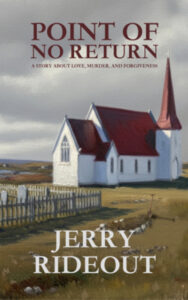
This obviously made quite an impression on you, but instead of approaching it from a non-fiction angle, you wrote a piece of historical fiction. Why?
For years, I thought I had the seeds of a true crime book. I dug into the man and the woman he killed, into witness accounts, into the likelihood that he’d committed the act during a schizophrenic delusion, and into rumours about the case. Some of that research was fruitful on its own, but taken together, it didn’t add up to the level of detail a factual, documentary account needs.
A good story needs a character who can change over its course, and from what I’d learned of these two real people, it was hard to see how either of them could have. She was shaped entirely by devotion to her faith, and he was shaped entirely by a mental illness neither he nor anyone around him understood. Among the witnesses I had almost nothing on was a local reverend, so I gave him a past, a bleak one, built around trauma from the First World War, and then let the murder and the people around it force him to face what he’d been carrying since his time in France. That’s Reverend Merrick Butler, and the book became his story as much as anyone’s.
I set the book carefully in its respective time periods. Readers will find the Wreckhouse stretch of railway in it, where a hermit really did keep watch on the wind and radio the rail company when it grew strong enough to blow the train cars off the tracks. The tidal wave that struck Newfoundland’s south coast in 1929 is in there, too. Beyond those, the book draws on the outport folklore and superstition of the era, the food and industries and modes of transportation of the time, and the institutions that shaped daily life, like the Salvation Army. I want readers to smell the salt air, feel the howling gales, and experience the times and the places as they were.
What was your research process?
I started at the provincial archives at The Rooms in St John’s, looking for the original court records. The archivist told me the files weren’t there, and I thought my project was dead in the water. A few days later, she called back with incredible news. She’d searched under the wrong monarch, forgetting that in 1931 Britain still had a king on the throne rather than a queen. Once she searched under the right case name (The King vs—), the trial records turned up.
Having those transcripts changed the book, even after I pivoted to historical fiction. Some of the testimony did become narrative, but the real value was in what it told me about the people involved and what they’d experienced. These were real people, and the record told me little beyond their names and part in the case, so I gave many of them backstories that brought them the depth the record couldn’t provide. Among them was the reverend, who, according to the documentation, had been performing a baptism across the road from where the murder took place as it happened. That detail made it into the book.
The research as a whole was eye-opening. Growing up, I’d heard versions of the story that turned out to be false. One rumour, that the murderer had been buried outside the cemetery fence on unconsecrated ground, was untrue, but it had lodged itself in local memory so firmly that I worked it into the story anyway.
You credit several people with helping your writing process. What is your writing process?
Many of my family members were arm-twisted into reading early versions of the manuscript.
The writing process was digging, drafting, relentless revision, and tough love from people I trust most. I spent five years on the initial research and draft, some weeks lost chasing a single historical detail, or worse, a line of inquiry that led nowhere.
And that was only part of the journey. The real transformation happened during the year-long editing process with my son, David, who works professionally in communications. He was my secret weapon. I’d hand him a draft I was thrilled about, and he’d give it to me straight: ‘Dad, there is some great writing here, but some of these parts don’t move the story forward.’
Cutting passages I’d grown fond of was occasionally painful, but his sharp eye kept the plot lean, intense, and gripping. Every page was questioned, polished, and refined. Point of No Return is a far stronger, richer book because of that father-son partnership, and readers will feel that momentum from the very first chapter.
Why and how did you navigate the self-publishing route?
Self-publishing gave me total creative control over the finished book, and that extends beyond the writing alone. Before retiring, I spent some of my career teaching digital page layout, photo editing, and web design. In fact, I taught the very first course east of Toronto on how to build and publish websites. So, while design and technology can be a massive barrier for many authors, I was able to format the book, design the cover, and build my own digital presence from scratch.
Since publishing my first book, a memoir called My Life in Short Form that chronicles experiences from my youth growing up in Newfoundland, I’ve connected with many traditional and indie authors, and have seen how hard it can be to get noticed in today’s market. Having complete ownership of my work allowed me to launch Point of No Return with the exact story, pacing, visual quality, and promotion I felt it deserved of me. Self-publishing has allowed me to shape exactly what makes it to the reader’s hands, and to ensure it is every bit as professional, polished, and compelling as a book from a major publishing house.
Point of No Return is available here.

