

“This strange little album has made such a splash”: Michael Cloud Duguay’s Kingdom Come, Kingdom Go
August 2026
Can you tell us a little about yourself?
I am a composer and producer based in Peterborough, Ontario, where I grew up. My artistic process is rooted in themes of memory, geography, radical collaboration, and the sonic profile of unique environments through innovative production methods. As a composer I am interested in synthesising electroacoustic sound art and folk music with drone, minimalist, and spiritual music traditions. As a producer, I explore my practice from the intersection of collective memory, location, and non-hierarchical community building. I frequently collaborate with Newfoundland-based engineer Jake Nicoll, who designed and built The Scamper, a solar-powered mobile recording studio that allows us to record sounds and music in all manner of far flung locations. First and foremost, I am a listener. Outside of music, I love gardening and the outdoors, reading, photography, and backgammon.
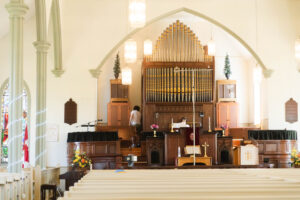
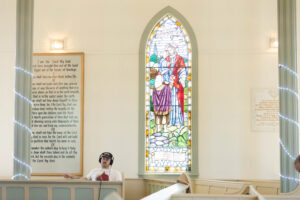
Here’s a description I have of your project: Kingdom Come, Kingdom Go centres around preservation. Many of the organs Duguay found on the expedition across Newfoundland in a solar powered mobile recording studio were located in churches that were closing, some of them in extreme disrepair, including one they had to unearth. Duguay sampled each organ to rebuild it as a digital instrument, thereby enabling its continued use. Duguay also sampled conversations with churchgoers and local residents.
Would you like to expand on that?
Alongside the album sessions, we sampled five of the churches’ organs so they could be transformed into playable virtual MIDI organs.By carefully sampling every key and capturing impulse responses of the reverberant spaces, we were able to create high-quality virtual instruments that can be played anywhere using a MIDI keyboard. Unlike synthesized or emulated instruments, sampled virtual instruments can remain remarkably faithful to their sources, because what you hear is an actual recording of a real instrument. We will be making these unique instruments available for practice, performance, and recording in the fall. In essence, anybody in the world will be able to download these digital instruments and play faithful representations of the organs that appear on the album.
What was the genesis of this unusual work?
All of the themes that I included in my self-description can really be boiled down to a simple desire to have fun creating art with my friends. I took a decade away from making music while I dealt with health concerns and when I returned to my practice in 2019 I quickly realized that time spent in conventional studios felt, to me, not entirely unlike time in hospital rooms. I understood that I didn’t choose to work as an artist – at this point, I had made this choice twice! – to abide by convention and play by other people’s arbitrary rules in spaces that don’t inspire me. Music and music production especially – even DIY and experimental music – has come to be dictated by narrow, normative ideals with outcomes that are in opposition to the feelings I experienced when I was young, I had no idea what I was doing, and I was having fun creating art with my friends. I genuinely do not want to lose that, and this project was essentially generated from that desire. This calling to be exploratory and adventurous aligned with an interest in church spaces and organ music, and Jake’s location in Newfoundland, and It all coalesced into this recording project and the attendant digital archival work.
What’s the response to it been?
The response to the album has been extraordinary. It’s received a really positive critical response from around the world, and I have received a lot of nice affirmation from new and old audiences. The album tells a lot of stories simultaneously – it tells stories about rural Canada and rural communities, religion and spirituality, climate change, it’s a simple road trip documentary – and all of these stories can combine in a lot of different ways depending on who’s listening. There’s lots to grab onto but at the same time it’s nebulous and obscure. It’s a curiosity! I think that what I described above – this adventurous approach to creating art – is distinct and discernible in the document and that people are drawn to this. It’s about as far away from generative AI as music creation and an artistic document can be. This wasn’t a motivation with this project, but it makes sense that people would be drawn to these themes and vibes. I can’t explain why else this strange little record has made such a splash.
What musicians/sound artists do you follow yourself? (This sounds like something that for example Brian Eno would think was pretty cool.)
Yes, I hope this work makes its way to Eno. I am a very omnivorous music listener and I dedicate a lot of time to music discovery and deep listening. Contemporary artists who I adore and draw inspiration from include Lucy Liyou, Klein, Natalia Beylis, Julian Klaas, Eiko Ishibashi, Park Jiha, Ian William Craig, Clarissa Connelly, Graham Lambkin. I could write a very long list. I love my friends’ music. I am really inspired by the work of producer Ian Brennan who travels the world in search of countries and languages whose music is underrepresented in publicly available music recordings, and produces albums of work via field recording.
What about other artworks – perhaps visual or literary – that inspire you?
For a few years now I have been deep into reading climate fiction; speculative fiction based on concepts of climate change and possible futures. I experience a lot of daily climate anxiety and a lot of that anxiety stems from not only how little action is being taken but how little actual discourse is taking place. I find comfort in the discourse present in these novels and the deep, speculative thinking behind them. My favourite has been Juice by Australian writer Tim Winton – devastating and beautiful, it provoked a lot of thinking for me. I am really inspired by the work of writer and researcher Kyle Devine, whose work focuses on the climate-oriented transformation of what music is and how it is made.
What’s next for you?
I begin production on a new, large-ensemble record next week in Halifax. Going on another adventure with my friends.
Photo credit: Noah Bender