

Helen McNicholl’s Impressionist journey: “How she accomplishes that, it’s pure mystery”
May 2026
“Helen McNicoll: An Impressionist Journey invites audiences to rediscover the career of a pioneering Canadian artist, whose luminous paintings captured everyday life, nature, and modern womanhood.
Celebrated by critics for her mastery of light and the immersive quality of her subjects, Helen McNicoll (1879–1915) helped elevate the profile of Canadian art on both sides of the Atlantic. She was elected to the Royal Society of British Artists in 1913, and the Royal Canadian Academy of Arts the following year. She died in 1915, at the age of 35.
Adapted for the National Gallery of Canada, Helen McNicoll: An Impressionist Journey highlights the artist’s depictions of work, harvest, and markets; her intimate portrayals of children and domestic life; and her vision of women as independent and socially engaged. The exhibition features more than eighty works – including paintings, sketchbooks, and rare archival materials – illuminating McNicoll’s complex and modern perspective on art and life.” – National Gallery of Canada
After a media unveiling and introduction to the exhibition, NQ talked with Katerina Atanassova, the Gallery’s Senior Curator of Canadian Art.
Thank you for taking the time for this,
I’m sure you’re having a very busy day! I wanted to start by saying, did you want to expand on any of the remarks that you made earlier?
I think one of the things that came up in the interviews in the galleries, the fact that she had such a short career –
– because she died so young.
Exactly. And so a couple of the questions I had by one of the reporters was about this idea of evolving style. And I pointed out that her first exhibition, or first submission, I should say, of three paintings, to the Art Association of Montreal is in 1906. She dies in 1915. So you have, really, in the nine years, of which she goes through schooling, she graduates from the very early landscapes, that are more indicative of the plein air of the Barbizon School and even the Hague School, which was collected by Montreal collectors, including her own father [David McNicholl] in Montreal at the time. So looking from that and then immediately, starting by 1907 and 1908 to paint this absolutely amazing, fully developed Impressionist landscapes is quite remarkable. So if we talk about evolution, that is really, to me, the most remarkable jump. And how she accomplishes that, it’s pure mystery in a sense. And I mean, not a mystery, but a few mysteries because she doesn’t go to France, or if she goes, she goes only once for a very short period of time. She studies at the Stade [School of Fine Art], which although opened to women, is still a quite conservative school. And then she ends up with St Ives, where, although she has a quite progressive teacher in Algernon Talmage, who was also a teacher of Emily Carr, by the way, when Emily Carr was there in 1901, it’s still a kind of a conservative place to be. These British artists who return after years of studying in Paris, or gallivanting across France could not even find a model to pose. Not just male, but even female models, would not pose because of the perception, the stereotyping, and so on. These are quiet fisher villages where the mentality is quite different than let’s say the hub of London. So the only models they had were children. That points me to a different direction because we should be very careful when we think, oh, they only paint the children. Well, these were the only models available because they couldn’t procure any models. So even new nuances like this, they’re adding almost daily as I continue to investigate the whole era and what’s happening in England at the time and reposition Helen from the history of French Impressionism.
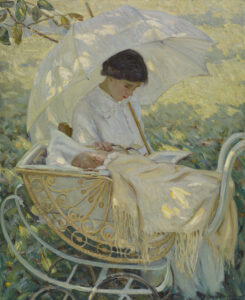
In the Shadow of the Tree, 1915, oil on canvas, 100 × 81.5 cm. Musée national des beaux-arts du Québec, purchase. Photo: MNBAQ/Jean-Guy Kérouac.
Because it’s touching on this ideas of a woman’s sphere, woman’s space, woman’s subject.
Yes. And although Helen is considered as one of the leading Impressionists she is not well researched. There’s only one book written by a woman artist [Samantha Burton] who just fell in love with her art in the 1980s but there’s nothing else on her. And she never dated her works. So for me, it was almost like a detective work to find works that are 1919 or 1915. I sort of just see where the similarities and the differences are. And whenever possible, we [related McNicholl’s paintings to] work by [British artist and McNicholl’s close friend] Dorothea Sharp. With many subjects, they painted together side by side.
McNicholl became deaf due to medical complications as a small child. Do you have any sense of how this might have influenced her technique?
That’s a question that comes up quite often. And I wonder, but when I look at paintings like Sunny September.[1913], where definitely there’s that sensibility towards the breeze, the ruffled leaves in the trees and the grass going against the wind, it’s kind of interesting to see that maybe because of the lack of hearing, she had the other senses a little more attuned, more attentive.
What about her own writing?
The only things surviving are thirteen sketchbooks, which are predominantly sketches, very little writing. And six letters to her father. She was very close to her father. And so she wrote to him extensively, long letters. One letter is nine pages, and it’s kind of a small, very interesting handwriting. And they are all from the 1913, 1914, and 1915. So one describes, in detail, what Dorothea, she calls her Dottie, has done for her in a sense of making their apartment in London a site of an exhibition so that she could be elected as a member of the Royal Society of British Artists. They held a reception. McNicholl’s work was seen, and so she describes in detail, how some of the older members. Society members, would go to Dorothea, and say, if that’s the direction where the art is going, then the Academy has it all wrong. In a sense, it’s up to young women now to change the course of British art. But she gets accepted. She’s one of the few, which is really remarkable. And it’s even more remarkable because after the acceptance into the British Academy, it is only then the Canadians accept her. These were these kind of reminiscences, and the nine-page letter, I found it fascinating. The [First World War] was just starting. In those days her father was the vice president of CPR, and they also ran the steamships across the Atlantic. And his employees were absolutely fighting to get the daughter of their boss back to safety, because the military troops were already moving into France at the time. So she saw quite a bit of it and she was describing to him in a letter, and how one of his employees came to pick them up and they didn’t even had a chance to pack their luggage. These are quite a remarkable moments, to see how the war started in the eyes of somebody who was there.
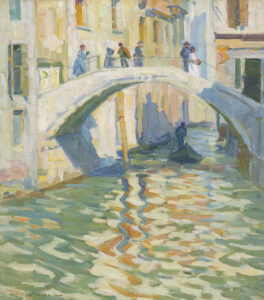
Footbridge in Venice, c. 1910, oil on canvas, 47 × 41.9 cm. Pierre Lassonde Collection. Photo: MNBAQ, Louis Hébert.
Can you talk a little bit about the logistics of putting something like this together, how far you reach out, kind of stuff you’re looking for?
We started here with somewhere between 59 to 60-something works. We now have 96 in total. So I’ve enlarged it. I added new themes. I expanded on the thematics to explore the depth and breadth of her practice. That’s why you see different themes, and I was searching for work that had never been seen before. I worked exclusively with private collectors across the country and I knew where the works were. It was just a matter of getting them. Some I couldn’t, for various reasons. For example, September Evening, which was awarded the inaugural Jesse Dow award in Montreal in 1908. We were planning to get it from a Montreal collector, and he died in December and his house was robbed, and the painting is now missing. So there were some instances like this, which I we lost the loans. But in general, all the loans worked very well. The reason why I wanted these works added was to augment the new themes, but to also follow my argument as to her closeness to the British Impressionist tradition rather than the French.
What kind of material do you look for to contextualize McNicholl’s artwork?
Everything, everything. I mean, my assistant even found the passenger listings of steamships crossing the Atlantic; we even found the menus the days when they were travelling. We have a lot of archival photographs. We have the original letters of our first director, Eric Brown,. And to imagine that [he purchased the first work from McNicholl] in a year when we purchased some important, very important other works by both Canadian male and European artists. Kudos for our first director, because this was considered Contemporary Art, and he would go in those days and attend all the important exhibitions of the entire Society of Artists of the Royal Canadian Academy, the Montreal Art Association, and he would select the best, and he would write those handwritten or type-written letters and say on such and such, the exhibition in such and such city, I saw this work and I want to acquire it for the national collection. And those letters exist there in archives. To me, that was one of the most important indications of how early there was support for women artists. You probably know the National Gallery had an exhibition of women artists, Uninvited. But my position was very strong against it because that was not the narrative. The history of the National Art Gallery from the very beginning shows a very strong support of women artists. We acquired them. We supported them.
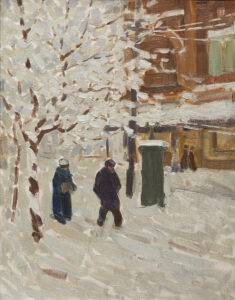
Montreal in Winter, 1911, oil on canvas, 45.7 × 35.4 cm. Pierre Lassonde Collection. Photo: MNBAQ, Louis Hébert.
So you wouldn’t describe McNichol ‘largely unknown’?
No, I don’t agree with that. Everybody who asks me, I would say she was definitely overlooked after her death. But during her life, she was featured every year in major exhibitions, whether in the Royal Canadian Academy, whether in the Art Association of Montreal, and the press was very, very complimentary. The reviews were always phenomenal. She dies, of course, in 1915. It coincides with the war. Everything stopped with the war.. What happens after she died and after the war, there were a couple of memorial exhibitions because we lost a lot of great artists in that period, not to mention Tom Thompson. He died 1917. James Wilson Morrice dies in 1924.
But to me, the reasons why she was overlooked are manifold and cannot be explained with one thing. And I do hope one day to publish a major book on that and really motivate people to look at differently. First of all, Impressionism is coming out of fashion, replaced by the a national school of painting, presenting only Canadian landscapes, and in a very kind of a rugged, masculine manner, the Group of Seven and Thompson. Helen paints in Impressionism. Helen doesn’t paint in Canada. So: foreign subject matter; Impression is not fitting in the national agenda of identity. So her work was very easily forgotten. And the other thing is, the family kept most of her work. So there’s no circulation, the public doesn’t know of her. Institutions didn’t own works by her. So it was not until the 1970s that the family started releasing some works and selling them. So that contributes. There are many, many factors. But to me, rather than just looking at it as, oh, she was a woman, therefore forgotten, I think it’s wrong.
A few years ago, I created an exhibition called Canada and Impressionism, and she was one of the leading artists. I had 12 paintings by her in the show. It was definitely part of this exhibition, what a Canadian woman artist can achieve. We’re far off of knowing everything. A lot more research needs to be done, but definitely we made a major, major forward step forward.
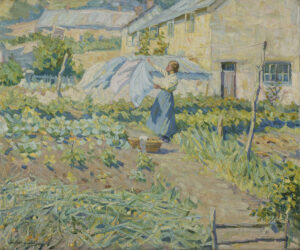
A Welcome Breeze, c. 1909, oil on canvas, 50.8 × 61 cm. Balsillie Collection. Photo: Toni Hafkenscheid.
Helen McNicholl: An Impressionist Journey continues at the NGC until October 12.