

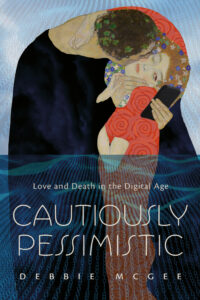
From Etiquette Lesson to Love Story: Debbie McGee’s Cautiously Pessimistic
May 2026
Let’s start by summarizing Cautiously Pessimistic.
Now I describe the book as a love story. It tells two stories. One is the diagnosis and death, within eight months, of Gerry Porter. my husband. And the other story that it tells is our tumultuous and somewhat scandalous coming together. as a couple [in the 1980s]. Ninety-ish percent of the stories come through documents, from both times. In the more recent years, that’s Facebook and Twitter, and email messages. It is amazing how you can pinpoint a day in time using those, because it turns out the trove of messages goes back as long as your phone was recording them. And then, for the earlier days, I had a journal that I could use, and some email. And lucky for me, even back 40 years ago, I had a computer so that letters I wrote to people, I still have on my computer. Even though it was such an old computer that its program doesn’t exist anymore, and I had to send them off to California to get transferred to a word format that I could actually open and read. It was like, ‘Oh, look. This is what I wrote in October, 1986,’ or whatever, and it was just delightful. And again, somewhat surprising to me to see what I actually wrote. Like, I kind of had big memories, but to see the actual words was really interesting.
Did you start out to write a book, or were you just kind of working through your own grief in a therapeutic way, and then saw that you had something there?
I started out to write an article. I wanted to write an article, not so much about grief, but about digital communications around grief and loss, especially for me on Facebook. Because I had found when Gerry died, that there was a lot of people posting, which was good, but not everyone was all that sensitive to the family. I had done some research, and I’d seen other people write about this, and I thought, ‘Yes, we need to find a new etiquette for this.’ We know the etiquette for expressing condolences in person, at a wake, and at the funeral. But what do we know about Facebook? On Facebook, everyone is equal. And if you’ve got an account, you can post on any subject, pretty much. But that presumes an equality that doesn’t really exist around death, because the loss to the family, the immediate family, is much greater than the loss to old friends or acquaintances from many years ago.
Gerry had a friend, a colleague from work, they were very close to Gerry, and really loved him and whatever. And so they posted a lot, because they had a huge social media following. And there would be thousands of condolences, and we would see them all, because Gerry’s name would be highlighted, and you get notified. And so we would see all these condolences, going to this person, that my sons didn’t know. And who hadn’t been very present during the eight months. And it just felt wrong. And so I wanted to write about that, and suggest that you do what you do in real life, which is wait a bit, and figure out where you are in the hierarchy of grief. And if you’re not in the sort of inner circle, then wait a bit till the inner circle has expressed themselves on social media. Then you can.
Though that sounds now, even to me, a little bit petty. But when you have had a loss, you’re just raw. You can’t take anything. Now it doesn’t seem that bad, but it’s been 10 years. So, anyway, that’s how I started out. And then, as I began to explore that, I also began looking into Gerry’s life. And all the things I didn’t know about him, especially high school and grade school, and things you don’t really usually talk to your adult partners about. I started interviewing his friends and trying to get a timeline of his life. That was kind of the therapy part, I needed to do that, I had to do that. And then I went to a writing retreat, it’s called Writing with Care, that was used to be held before COVID, at Ochre House every year. I began to actually try and put sentences and paragraphs around things. Still not really thinking about anything like a book. Towards the end of the summer, I ran into Lisa Moore out at Woody Point at the Writers’ Festival, and I was telling her about this, and she said, ‘Oh, you should take my writing class.’ And I said, ‘Oh, no, I’m not an author. I can’t take a place of some real writers.’
But as a filmmaker didn’t you write screenplays?
I did. And she pointed that out. And she said, ‘Well, I’m offering you a place in my class. Take it or not.’ And of course I want to take Lisa Moore’s class. So, that was the thing that really changed everything, because in a class like that, you have an assignment, so many words per week, or every two weeks, but you also have to share that work with people. And so I saw that people were interested; there’s a huge variety of ages in a class like that but even the young people were interested in what I was writing about, had things to say, could be touched by things. By the end of that class I had the little series of essays on what has become the cancer story in the book, going from diagnosis to death. And Lisa said, ‘I think this could be a book, but you’d have to add a lot more detail.’
I took more classes, this time with Robert Finley, creative nonfiction. And expanded what I had done in Lisa’s class, and then added the alternate chapters. And from the reaction of the classmates, from all three classes, I thought, ‘Yeah, could be something here.’ And then COVID hit. And everything changed, and I didn’t work on it for a while. But then I thought, ‘Oh, well, get that out.’ And I did some revising, and I used the program from Writers NL, the manuscript evaluation program, which is really great. The [editor I was matched with] took it seriously. One of my questions was, ‘Does my love for Gerry come through?’ Because I was worried that it was sounding maybe too analytical or too critical in some ways or whatever. And she said, ‘Oh, yeah. But, you know, if you want, you can always add stuff.’ After that, I worked on her notes for a good while, and then I eventually got to that point where I’d have to submit. Oh, my God, it’s so scary. I was talking to Larry Mathews, at some event or other, and he said, ‘I’ll read it if you want.’ ‘That’d be great. Thank you.’ He read it and said, ‘Yeah, submit it. Don’t make changes. Your editor will.’ And so, I did. And months later, got the letter from Breakwater. So it was a long journey. I started writing it in 2017, and the book came out in 2025.
I wondered if the parts that were hardest to write about were the parts that were hardest to actually live through?
I would say that the writing of the cancer story was in some ways easier. Because that was definitely therapy. Because it was all so fast, and every day things are changing, you’re responding in the present moment. You don’t really have that much chance to evaluate what is going on. But things are going on. And you have to deal with today’s things, not yesterday’s things, because it’s that kind of event. So the writing of that was really good, and I had so many sources to help me figure out when was that? You’d have your appointment book, and you’d have all these tweets that would have a time stamp on them. What night did we go for dinner at – ? That’s easy to find out. And so I could do the chronology of it. And the hardest part with that was, what to leave it and what to leave out. And when I knew it was going to be published there were things I had to check with people. Writing the story from the past was probably harder, because there were a lot more people and a lot worse behaviour. Because we were all young, at that point. We didn’t have kids. People were exploring. People drank a lot more than, too. And people who were maybe taking drugs but weren’t taking the hard and dangerous drugs that are so prevalent now. It was a time when you could sort of do that and still get away with it, still function.
Is grief memoir its own genre?
I know that when they do the little words for the meta thing, they always put grief – grief, death, cancer. So I’m assuming. I mean, that’s part of life. I think that probably, if you look at all the people who’ve written memoirs that are focussed around the death of a loved one, you would have tons of books.
And what’s the response to your book been?
The response has been very good. People who knew Gerry had very kind things to say about it, and people who didn’t know him say, ‘Oh, he seems so funny, and I would wish I had known him,’ that sort of thing. And Gerry’s art, some of Gerry’s cartoons and artwork are in the books. There’s a chance to see him as a person. And one of the people we used to work with said, ‘Wow, it’s almost like he’s a co-author.’ So I really liked that. For years, I didn’t think it was a memoir. And I was like, ‘It’s not a memoir. It’s about Gerry.’ But it’s clearly a memoir. It’s a creative memoir. Now I accept it is my story, too. And so many people relate to it. The follies of youth, then and now. And I’ve got a lot of people who have written to me, I’ve have cards in the mail, a lot of people contacting me through social media and just saying how much they love the book and how much it would help them or touch them. Even one person who themselves had a terminal diagnosis. and had picked up the book while they were in St John’s, and said, ‘I think this is really going to be helpful to me and my family.’ That’s very unexpected. And then just some nice reviews, and so, all in all, I’m very happy with the way the book has been received – and then it was long listed for the Winterset, and then short listed – it’s great to be a finalist for that prize. At the moment, I’m trying to organize some book readings.
Is there something I haven’t asked you about the book that you’d like to talk about?
Many people who read the book comment on the sense of community. Then and now. Then people maybe knew too much about your business – but they did care. And people say, since they read the book, they are more careful in their own posting, and that sort of thing. But at the same time, it feels a bit scoldy. So I said that to someone the other day, ‘I don’t want to feel like I’m scolding people.’ She said, ‘Well, yeah, but maybe, maybe people need to think about changing their behaviour.’ But in that sense, in many ways, the book is about love, it’s about family, and it’s about community. So, even though it’s a sad story, it’s a happy story.
This interview has been lightly edited for length and clarity.