

“There’s an ease and freedom to making up a story, paring it down, sending it away; anything can happen to it then”: Nicholas Ruddock takes us around Planet Earth
February 2026
You are very versatile with literary forms – with the NQ alone you’ve published non-fiction and poetry, and you’re also a novelist, with Last Hummingbird West of Chile just released as an audiobook. What does working within the short story format allow you to do/restrict you to?Short stories can pack a major wallop and do it fast. For example, Ken Lum’s “Paper Menagerie” or Alistair MacLeod/Alice Munro/Mavis Gallant/George Saunders/William Trevor/James Joyce, such a rich history in the short story that it would be madness for any writer not to give it a shot.
Plus the shorter time investment, plus a hundred brave magazines willing to publish them, plus a hundred “contests” offering actual money and a guarantee they’ll be read rather than trashed. So there’s an ease and freedom to making up a story, keeping it to 10,000 words or so, paring it down to 5,000 or 2,000 or even 250, sending it away. Anything can happen to it then. For example, one of my stories was published in The Fiddlehead and was subsequently filmed by the Canadian Film Centre, directed by Ana Valine, starring Kate Corbett of Holyrood, narrated by Gordon Pinsent, shown at the Nickel Festival, all out of the blue.
There is no downside to writing short stories. Writing novels may be received with more rapture, but the writing of the story itself has no limits.
Personally, regarding the short story, I was very lucky that James Langer and Rebecca Rose of Breakwater Books took my Newfoundland-based short stories and welcomed them, much as I was welcomed, when starting out as novice physician, in St John’s and Fortune Bay. Thank you to those early times. And thanks to House of Anansi for accepting Planet Earth, in which the stories range from 250 words to 10,000.
Your stories are often borderline fantastical in settings and events, and your protagonists unusual, and sometimes animals. Where does this approach come from? Would it be fair to call it magic realism?
I hadn’t thought of it as magic realism but it’s true, as you point out, that many of the stories present the “borderline fantastical” as “real”. I think the momentum of the subsequent telling abolishes any disbelief that either I had in writing it or a reader might have in reading it. For example, my first published story, when I didn’t even know if I could produce 2,000 sensible words, starts on a foggy day on the South Coast, a couple with a two-year-old driving to a nursing home through such thick fog that they had to navigate by the feel of the tires, by the crunching of gravel or the softness of the grass shoulder, weaving back and forth between the two. Total whiteout. I guess that would never happen although maybe it did and it got me quite caught up and the family sure was happy together.
As far as animals go, in Last Hummingbird it only made sense to give a voice to the voices we seem unable to hear, and once they started talking they were 100% believable to me and to most readers, somehow, because animals and trees and bugs had the same desires and dreams and even worse problems than humans.
What writers do you most read, and are most influential for you?
I have read thousands of books starting at age five. Starting in 2013, I kept a record so I’d remember better, and so I can tell you that in these last 15 years I’ve started 284 books, all fiction but for one or two. Finished at least 250 of them. I like in particular the Irish and the Canadian and the Latin American and the Russian and the unsurprising names not already mentioned above would be Nabokov, Bolaño, Sebald, Vargas Llosa, Saramago, McCarthy, Modiano, and I could go on and on but recently the Irish women in particular Edna O’Brien and Anna Burns and Claire Keegan and Claire-Louise Bennett who is English but lives, I understand, in Sligo or Donegal. Some of Wayne Johnson, much of Michael Crummey, all of Ray Guy whose stories I read aloud to my wife when she was in labour in Montreal, both of us laughing so the nurses wondered, was she really in active labour or not.
What artists or artworks, beyond literature, most influence you?
Music: I listen to Tom Power’s CBC playlist or to French radio when writing. In Belleoram the band played “The Four Mary’s” so I got enamoured by traditional NL and Irish/English music so now I play the penny whistle not very well and when we were in St John’s we’d seek out the sessions at Auntie Crae’s or Erin’s and we’d actually stepdance at O’Reilly’s so music is #1 for me as an influence. There was a fiddle player in The Dardanelles who was a doctor-to-be, which I admired. We saw Jodee Richardson singing either about being medicated or not being medicated and I thought it powerful. My wife is a painter so we have been to a hundred galleries and museums and now and then Matisse or Picasso has snuck into a paragraph here or there.
You’re part of a tradition of physicians who write – Chekhov possibly the most famous. Any thoughts on that? I think readers wonder how such busy professionals can possibly find time to write, but maybe the two pursuits complement each other?
I’ve done most of my writing recently, after semi-retiring. So being busy hasn’t affected me that much. Regarding doctors who write, maybe there’s a self-selection process in adolescence, certain boys and girls being attracted to a profession that offers solace as well as a reasonable living. That’s the only explanation that makes sense to me, and I know that in my medical class were poets and pianists and visual artists.
What project is next for you? Will you write a memoir/autobiography?
I’m still writing short stories and sending them out into the world. I have a poem “Fentanyl” in the next Dalhousie Review. I’ve written a few memoir pieces, mostly for NQ, but I don’t think I have the degree of honesty required to make a full autobiography. It’s better for me to imagine a fictional life than portray the one I’ve had, however interesting and lucky it’s been.
When Fogo lost its only doctor in 2022, the situation well-publicized, I thought I might be able to jump in and fill the gap over the winter. But I’d given up my Ontario medical license in 2019 so I was deemed obsolete, my offer refused, despite the fact that I knew so much more in 2022 than I did in 1972. Then I was accepted without hesitation as District Medical Officer, Fortune Bay, although I was as wet behind the ears and as smart as your average sculpin. So that was disappointing, but in retrospect I think the right decision was made by the authorities, maybe.
I was just enamoured by the possibility of living once more those lyrics from Great Big Sea: “To play our hand in the Newfoundland where the wind cuts like a knife.” But too much time had passed, the wisdom of the elder overlooked.
Planet Earth is published by House of Anansi.
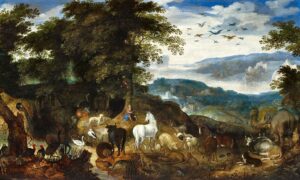
(Image: Jacob Savery, Orpheus Charming the Animals and Trees with his Song.