

The Story of CB Nuit and the Woman Who Dreamed in Colour
March 2026
By Blessing Adebimp-Adedokun
The streets of Corner Brook do not often glow at night. But once a year, when summer turns to fall, light spills out from alleyways and windows, sound vibrates through West Street, and families wander through a city transformed. This is CB Nuit: an art-at-night festival that turns Corner Brook into a living gallery, a moment where creativity feels communal, free, and alive.
Over the past few months, I have had the privilege of working closely with the woman at the heart of it all: Louise Gauthier, the festival’s founding director and creative force. When we sat down for this conversation, it became clear to me that what began as a single spark of imagination has become a luminous story of collaboration, sustainability, and love.
Beginnings: A Light in 2017
“Hmm,” Louise smiled when I asked about the first CB Nuit. “I can’t say that I completely imagined it. I have to give due respect to David Smallwood, one of the founders of the Rotary Arts Centre. He was the one who had the idea to have an art-at-night festival. He’d seen them in other cities and thought, why not Corner Brook?”
It was 2017, the year of Canada 150+. Smallwood received a grant to launch a festival but lacked the capacity to run it himself. That’s when Louise stepped in. “He asked if I’d help. I took it on,” she recalled. “And the rest is history.”
History, indeed. CB Nuit turns ten next year. What began with a modest grant and a few bold ideas has grown into one of Newfoundland and Labrador’s most anticipated cultural events.
Louise remembered that first night vividly. “It wasn’t a huge amount of money,” she said, “but I wanted something that would really bring Corner Brook out. So, I called Wonderbolt Circus in St John’s. They came – and it took a big part of our budget – but I thought it was worth it.”
She laughed softly. “It meant that families who couldn’t normally afford the circus could bring their kids to the street for free. They got to see the circus, and at the same time, they were surrounded by contemporary art. It became this wonderful mix of joy and exposure.”
As she spoke, I pictured the scene: the smell of popcorn, the chatter of children, the cool air of early autumn mingling with the electric hum of performance and light. CB Nuit, from the beginning, was about creating something for everyone.
Building a Community of Light
When I asked if she had anticipated such a warm community embrace, Louise shook her head. “It’s not easy to get people out around here unless it’s something familiar or exciting,” she admitted. “But that night did it. The following year, we went into the elementary schools. We had 350 children create self-portraits from recycled materials, which we hung on an 800-foot string downtown. That meant 350 families came out to see their child’s work.”
She paused. “That’s how you build momentum. That’s how art belongs to everybody.”
As she told the story, I saw the thread that runs through her vision, a belief that art should not only be seen but shared. “I’m a come-from-away,” she said, “but I’ve been here 17 years now. What struck me was how rich the cultural fabric is. There are so many artists working in their own pockets. I wanted CB Nuit to be the night that connected them all.”
The festival became a meeting ground for professional artists, students, businesses, and families. “When you invite people to be creative,” Louise smiled, “they always surprise you.”
Challenges and Lessons
Louise’s journey wasn’t without its challenges. “The hardest part was learning how to apply for grants,” she laughed. “I had to figure out all the municipal, provincial, and federal systems. And then building a proper structure – a board, a team. It’s a lot of small details that add up.”
But she was quick to add that the local spirit kept her going. “Every business on West Street said yes. Everyone wanted to be part of it.”
When I asked what she’d tell her younger self, she thought for a moment. “I’d tell her to swim regularly, eat well, stay grounded,” she said. “It’s easy to get overwhelmed. And I’d remind her: trust your instincts. Believe in what you’re doing.”
She grinned, calling herself “an optimist by nature.” “I’m really good at convincing people to do things,” she said, laughing. “I call it ‘Obi-Wan Kenobi-ing’ people.”
Sustainability as Philosophy
Few directors talk about sustainability the way Louise does. For her, it’s a living, breathing concept. “We look at everything: what’s the carbon footprint of a project? What is it made of? What is it communicating about health, community, and environment?”
She gestured as she spoke, her hands painting invisible patterns in the air. “Our space is the street,” she said. “We don’t have to build structures or buy plastic. We borrow equipment from other arts groups instead of everyone buying their own. We share. That’s sustainability.”
CB Nuit also models social sustainability. “We reach out to underrepresented voices, the Corner Brook Aboriginal Women’s Association, the Qalipu First Nation, the New Canadians Association. It’s about inclusion, not tokenism,” she explained. “And every year, we open with the drumming of the Aboriginal Women’s Association. It just opens people’s hearts.”
Themes and Renewal
CB Nuit has since begun to adopt a theme that reflects the mood of its moment. “Our first was Home, because it was Come Home Year,” Louise said. “Then Illuminate: after COVID, we needed light. The next year was Spiral, because we were going through dark times globally and wanted people to engage that truth. And this [past] year was Bloom, to remind us to grow again, to find joy and connection with nature.”
As she described the Bloom installations, flowers glowing across the city, I remembered standing among them that night, feeling the hum of quiet joy ripple through the crowd.
Accessibility and Care
CB Nuit is also a festival that pays attention to the unseen. “Festivals can be overstimulating: lights, sound, movement,” Louise explained. “So we created a low-sensory space called Silent Skies, with weighted dogs, fidget stones, and calm textures. It’s about accessibility and care.”
As she handed me one of the soft, handmade “weighted dogs,” I felt the small comfort of its warmth. It was a quiet metaphor for the festival itself: a place where energy meets gentleness.
The Art of Reuse
Recycling and repurposing are at the heart of Louise’s vision. “We’ve had installations get second lives,” she said proudly. “A shadow puppet theatre became a dance stage the next year. We’re even building a shed to store installations we want to reuse.”
When we talked about fashion and sustainability, my own area of research, her eyes lit up. “There are enough clothes in the world,” she said. “That’s why your project with the Grade Six kids was so exciting: repurposing thrifted clothes into wearable art. It’s all connected.”
Her voice softened. “Newfoundland already has that culture of mending, quilting, reusing, making do. Sustainability isn’t foreign here; it’s part of who people are.”
Looking Ahead
As CB Nuit nears its tenth anniversary, Louise is thinking about continuity. “We’re developing an artist residency program,” she said. “It’ll bring artists from different disciplines together to collaborate on large projects, mentored by experienced creators. It’s a big step.”
The festival also reaches beyond Corner Brook. “Last year, we were invited by Historic Sites of Newfoundland and Labrador to showcase projects at the Colonial Building in St John’s. It gave those works a second life.”
Her pride was evident when she spoke about the youth mentorship program. “We go into high schools, recruit students, match them with mentors, and let them present alongside professionals. A few have gone on to study visual arts because of that experience. Nurturing the next generation is sustainability too.”
The Heart of Leadership
When I asked what CB Nuit has taught her about leadership, Louise thought carefully. “Leadership is about giving agency,” she said. “It’s organizing, but it’s also trusting. You can’t do everything yourself. You build a team and believe in them.”
She laughed recalling how she once ordered pizzas for volunteers at the last minute. “Sometimes leadership is as simple as feeding your people,” she said.
When asked how she’d like to be remembered, she paused. “I’d like people to say, I’m glad Louise Gauthier was a believer. That she had the imagination and energy to bring this together.”
Then she smiled. “A lot of love goes into this festival. Love and trust. When you believe in people, they really come through.”
Epilogue
After our conversation as the lights of Corner Brook were beginning to fade into dusk, I thought about what Louise had said about light, sustainability, and faith in community. CB Nuit is a living dialogue between art and people, between creativity and care. In the quiet glow of that realization, it was easy for me to see why CB Nuit endures. It is not just a night of art, but a testament to what happens when someone dares to believe that a small city on the west coast of Newfoundland can become, even for one night, a constellation of light.
CB Nuit’s Calls for Artists go out at the end of this month for their 10th Anniversary Festival, which will be guided by the theme: FLOW
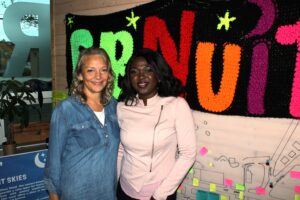
Blessing Adedokun-Awojodu is a writer, educator, and sustainable fashion researcher based in Newfoundland and Labrador. With a background in literature and a keen eye for cultural storytelling, she brings thoughtful insight and emotional depth to profiles, reviews, and features. Her work often explores the intersections of art, identity, and community. When she’s not writing, Blessing facilitates creative workshops that empower people through fashion, sustainability, and self-expression.