

Katherine Knight launches her BOAT: “A model allows us to hold or behold a maritime experience at human scale.”
March 2026
Can you tell us a little about yourself? You work as a photographer and a filmmaker – where does BOAT fit into your usual imagery/subject matter?
One of the most satisfying aspects of BOAT was the comfort I found in connecting threads from early in my career to now. it is my first book. Within the covers I could link disparate bits of stimulus – different photographs, places, experiences, stories, facts suddenly revealed interconnections that were immensely gratifying. I could include a photograph I made in 1978 in Harrington Harbour, Quebec, alongside photographs made recently and collectively they share an aesthetic and conceptual throughline. Working in different media can be a handicap as your life’s work can appear disjointed or mutable. BOAT gives me renewed confidant while my creative path might meander – it is travelling its required route.
BOAT follows a creative methodology that was present in my earliest photographic work as a student at NSCAD 1977-80. All my works are anchored in firsthand observation of physical sites or geography and individual experience. I work with the immediate physical world that I – or my subjects –experience. I am visualizing the physical world from a perspective of emotional experience. I seek to juxtapose what I see with what I feel. In my films on artists, I create a visual record that helps audiences feel and understand the physical environment of creative labour such as making work or living a studio-based life along with its lived consequences and the emotional requirements of creativity as a priority. I use the same toolbox in my film works, photography, and text-related work. My work in photo and film relies on combinations of story and image intertwined though creative labour, intuition, purposeful camerawork, and trial and error.
I was a student at NSCAD in 1978 when Robert Frank visited our class. He liked my photographs. Quit school and photograph – travel. I followed his advice. I didn’t drive at that point. Instead, I booked passage on a freighter boat delivering supplies to local communities between Quebec and Blanc Sablon. I got off for a month in Harrington Harbour and later had a very quick stay in Cartwright. The photographs I made on that trip became a 5-panel photo text work called Blanche. The foundations of my creative practice were established at that time. (Yes, I did go back and graduate!) (Please see ART STATEMENT* below.)
It was so nice to read about your connection to Colette Urban – I was lucky to know her slightly. And in a way she was the genesis of the idea for this book.
Yes – Colette work and her creative process remain vivid to me. I cherish her wild sense of risk, experimentation and ease of depicting a realm of the uncanny.

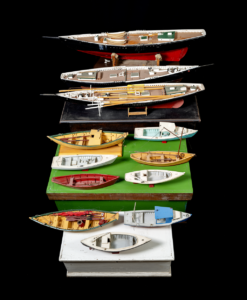
Image at top: White Schooner. Image above: Assorted Models
Why focus on model boats, instead of actual boats? Many at first glance do look “real” but then a second glance reveals their scale – it seems you’re always careful to include visual ‘clues’.
Ha ha – real boats are too big to photograph! I can’t pick up a real boat and position it for my camera. I can’t play with it. You can’t squeeze a real boat into a camera frame unless you are so far removed that details dissolve into the whole. A model fits in the camera frame and is full of detail. The model alludes to real experiences. It allows us to hold or behold a maritime experience at human scale. A model is not bigger (usually) than us. But it opens channels of metaphor and imaginative that are vast and beyond human scale.
Book scale is different from exhibition scale. When seen large the photographs take on an extraordinary uncanny feel. At first glance the viewer feels the boat is real. Then you notice details. The steering wheel is a thumbtack, or a raindrop is bigger that the boat’s anchor.
You are right, I try to include some details that expose the truth even when seen small in book form. I also love the humour and love that is present in the models.

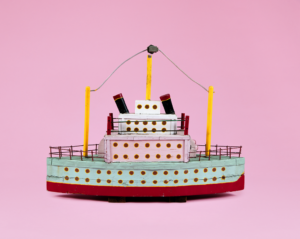
Image: Folk Art
There’s such a range – some model boats are created as a hobby or folk art, others build as instruments of maritime instruction – is there a throughline to these crafts?
There is very little published about model boats. There is literature about scale, small things, collections in general. But I didn’t find much to read about model boats as an undertaking. But overall, these following uses became evident – to remember, share, test, teach. I added the idea of connecting models in an archetypal way to water and our paradigm shift from analog to digital.
Initially I grouped my photographs into piles of winter, summer, and on display.
Then – the interviews helped me find throughlines based on the impetus or use of the model. This led to the chapters groupings and a way of organizing the models.
Watson Knickle: remembers his short fishing career. The models help him connect to experiences he values. When he makes a model, he can imagine himself out to sea.
Robert Wilkie : he underscores how powerful water is in human consciousness. Tangentially model boats connect us to oceans and water
Sara Spike; her essay on weather is about observation. Model making is a top example of close observation and slow ways of working. To make a model means to deeply observe.
Jim Turple: this essay speaks to how models circulate as gifts between generations and individuals. I find this poignant as these links are all breaking – the gift exchange of model ends as model making diminishes. Also, the remaining model makers are more uniform in making to scale – accurate – as per plans models – less likely to be shared for fun or by impulse.
John Rae: Teaching and testing. Models are disappearing with our paradigm shift to digital. Fo me this is big part of why models matter. The first shift to digital and now the move to AI – all these come with losses in the analog ways of understanding.
Mark Boudreau and Greg Hiltz: Greg says I realized I was making history. So true. Boudreau made 73 models. 40+ were museum quality. Now his collection of models is scattered. Together his collection would tell 43 stories about working boats in Atlantic Canada.
How did you select the included essays? And can you comment on the beautiful design – the structure of the book is unusual; it’s almost like a box.
The interviews came about instinctively and through poking around.
The guest essays were chosen more purposefully. They help stretch the meaning of the book. They anchor the book in meta themes.
Sue Goyette underscores ideas of evocation and understanding facts yet being subjective. Sara Spike wrote about a previous work titled Caribou Mottos about a collection of 19th c needlework with mottos of the day. I was astonished to find that Sara was writing a book about fog. She was doing research on weather reports from the 19c century – something I too was interested in. My brother William Knight is historian and curator at the Science and Tech museum on Ottawa. He introduced me the wind tunnel models and thus opened the idea of models as teaching tools.
DESIGN: we are so proud of the book and its design. This is designer Carter Pryor’s first book apart from grad school and personal projects. We have worked on other items since we first met and are continuing new projects.
Carter used a typeface called Gibson designed by Canadian designer Rod McDonald. We wanted to emphasize the local aspect and the sense of valuing here – Canada and the Maritimes. We wanted a book that was an object. The Swiss binding gave us that quality.
Notice the subtitles in each chapter. Carter gave a wave-like movement to the name, place, their profession. Those details all matter. Some images flow off one side of the page. Some stretch across the spine.

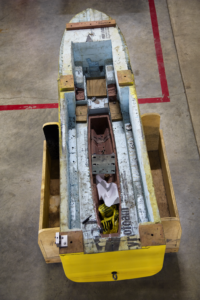
Image: Towing Tanks
BOAT is published by Goose Lane Editions.
Images from BOAT copyright © 2025 by Katherine Knight. Reprinted by permission of Goose Lane Editions. For more information, please visit www.gooselane.com.
*ART STATEMENT:
“A freighter journey from Quebec to Labrador shaped my photography. An adventure, a chance encounter, memorable quotes and the experience of photographing unique sites and scenes: all these synthesized into Blanche, my first exhibited series in 1978. Consistently, I work between observed detail and subjective experience, between fact and imagination. This approach to subject is evident in my book, BOAT.
BOAT: Photographs by Katherine Knight, published by WORK BOOK and Goose Lane Editions in 2025, organizes 66 photographs from my model boat series into eleven chapters, each headlined by black and white photos from my back catalogue, four guest essays and first-person accounts from model makers. In her text, Toronto-based writer and curator Peggy Gale reflects on models as, “An embodiment: something to hold dear and with which to become one.” For the BOAT project, I took models into the ocean specifically to allow the camera to do its work reimagining static artifacts in real time and place. Model makers in turn provided stories – connecting audiences to experiences otherwise lost. This modest-sized book relies on its well-crafted material presence to create unexpected intersections. At exhibition scale, the photographs take on an uncanny quality.
Water is a reoccurring thematic in my work. I became unconscious, 1995, is a multi-component work exploring choice, chance and death. The word WHY is spelled across three large scale BW photographs of water displayed on a wall painted caution yellow. 11 silkscreened yellow plywood panels spell out “unconscious,” each letter superimposed with a phrase recounting a moment of decision-making: Not How, Not Now, Not Why, Not Tidy, Must Be, Not Conscious, Get Off, Get On, Get Away, Touch Bottom, Let Go. Nine black and white photographs of water, including four superimposed with punctuation marks, suggest pace in thought, speech and comprehension. On May 24, 1881, the sternwheeler Victoria sank in the Thames River in London, Ontario. Close to 200 people drowned in twelve feet of water. One survivor recounted, “I became unconscious and let go my hold, and would have perished in the struggling mass had not some kind hand pulled me ashore.”
BOAT includes an interview with Captain Robert Wilkie who hosted me for two freighter journey projects. The resulting works, Navigate: Sorel to Harve Saint Pierre (2002) and my documentary film KOOP (2009,) were influenced by Edwin Hutchin’s 1995 book, Cognition in the Wild, and his idea that all systems of navigation fundamentally ask the question, “Where am I?”
KOOP: The Art of Wanda Koop (2011,) is one of six films on Canadian artists that I have produced, directed or co-directed through my company Site Media Inc. I see these film portraits, including Annie Pootoogook (2006), Pretend Not to See Me: the Art of Colette Urban (2009), Spring & Arnaud (Spring Hurlbut/ Arnaud Maggs, 2013), Still Max (Max Dean-2020) and the film Strange and Familiar: Architecture on Fogo Island (2014,) as both a public service and part of my overall practice.
What next? Hutchin’s phrase, ‘Where am I?” remains a guiding thought.