

“I put the book together the way I used to put together what we used to call a mix-tape” – Sue Sinclair releases New-Fangled Rose
April 2026
Could you tell us a little about yourself? I understand you grew up in Newfoundland.
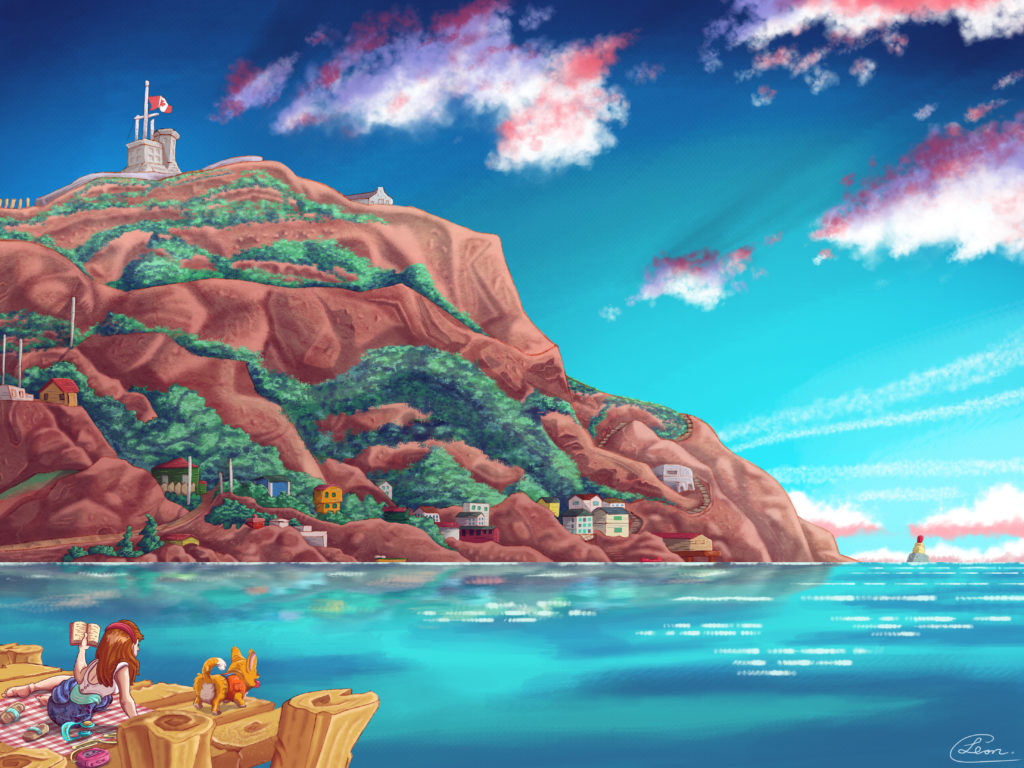
I did! My family moved to St John’s from the town of Fergus, ON, when I was seven, and I lived there till I went away to university in New Brunswick. My dad (Scottish by birth) visited Newfoundland in the late 1970s and fell in love with it—like everyone does. He got my mum on board, found himself a job, and we moved. One of the poems in my new collection says “I grew near an ocean”: the “I” is me and the ocean is the Atlantic. My parents still live in Newfoundland and I visit at least once a year.
Were the poems written in any particular order, and how did you sort them into these four ‘chapters’? And how did you cull the ‘chapter titles’ from the poems?
I’m hard pressed to remember the order in which the poems were written, but certainly the order of the book is different from the order of composition. In a collection like this, where there’s no obvious structure dictating which poem goes where, I put the book together the way I used to put together what we used to call a mix-tape (you’d probably say a playlist these days). I like this analogy because we’d make mix-tapes for someone we were close with or hoped to be close with, and that’s the kind of intimacy I imagine poems creating. So, as with the songs on a mix-tape, I think about how one poem follows another, what continuities or contrasts they offer each other. I think about the pattern of emotional ups and downs they create. I think about dark and light. I think about which poems might need a little more room to breathe, could use a little more silence as they close: those poems I place at the ends of what you’ve called “chapters.” I don’t know that the chapters are strictly necessary, but they create opportunities in much the same way that stanza breaks do within a poem. A chance to let something go, a chance to make a turn, a key change.
There’s a variety of formats – do they shape themselves? Do you ever decide just to play with a particular form?
Starting with form is rare for me. When I’ve tried it, the poems often haven’t come to life. But I do read with an eye to the variety of forms that are out there, that are being repeated, tweaked, or invented. I build a vocabulary of formal possibility, then when I’m focused on something in a poem-writing way, the poem falls into the shape that works best for it. I say “falls into” like it’s effortless, which it isn’t. I work hard at form, at nudging words into place. And I shape-shift my poems, try out the words in different patterns to see what suits them best. I’ve done a lot of dance, and sometimes it’s fun to try a piece of choreography to a piece of music it wasn’t designed for—it’s amazing how the dance will change its character, different rhythms or points of emphasis appear. It’s the same with words arranged into different patterns on the page: their character changes.
There are such rich juxtapositions in your work: in one line there’s Plato’s views of the moon, and next the simple statement “We just did”; classical references in footnotes and citations from scientific journals; asides to Kantian philosophy. And each page has remarkable lines that reward repeated readings, like: “Winter takes its pins one by one out of the fabric to see if the seams / will hold, and they hold.” How the heck do you do it? Can you talk a little about your writing process?
One thing I’ll say is that I’ve learned over the years that I tend to write best about something I’ve experienced IRL. Books and the internet connect me to so many astonishing features of the world, things I’d love to write about, but often if I don’t have some element of real-life experience to draw on, the poems fall flat. It’s a little like plein-air painting—and I do like to write plein-air, in the outdoors, weather permitting. There’s something about the actual, material encounter that helps the poetry happen. It may be connected to the fact that poetry—at least as I practice it—draws on mind, feelings, and body, and real-life encounter helps me engage in all those ways together. Not that body, feelings and mind are ever really separable, but sometimes one element of self is called on more than others, and I love poetry that speaks to all dimensions of me. Both the Kantian thinker and the sewer with pins in her mouth, to take up your examples.
You obviously pay a great deal of close attention to the natural world. Alongside its beauty – a word you employ many times – there’s a throughline of climate anxiety, even mourning. Is this counterbalance of observation and sorrow something you carry daily?
This is a good question. I spoke above about the integration of mind, feelings, and body, and the climate crisis is a challenge to that integration. Because if I really understood, in mind, feelings, and body, what’s going on … I don’t know how I’d manage to continue, don’t know how I wouldn’t curl up in a ball and weep without end. So I think that I have, unconsciously, disconnected what I know in the abstract about the climate from body and feelings, ongoingly prevent myself from fully realizing it. I’m only capable of that in moments, if at all. Climate disruption is only just creeping into my daily lived reality; it’s ignorable. But that disconnection doesn’t feel good; it feels like being only half-alive. So perhaps poetry is a place where I attempt to connect to the dawning climate reality—at the same time as I want to pay tribute to the beauties of where I am, of what’s here now: the river, the crab apples, the lupins, the snow … In that sense, observation leads to sorrow, because those observed beauties feel so fragile at this point in history. But they’re still here, and deserve to be celebrated.
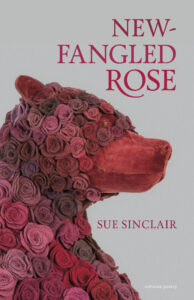
New-Fangled Rose is published by Goose Lane Editions and icehouse poetry.