

From the Spring issue: Between two worlds: Jackie Winsor’s enduring bond with Newfoundland
April 2026
By Courtney Zwicker
Jackie Winsor left Newfoundland as a child, but the island never left her.
Throughout a groundbreaking career that established her as one of the most important sculptors of her generation and a trailblazer for women in contemporary art, Winsor maintained an unbreakable connection to the stark beauty and resourceful spirit of her birthplace.
Born in St John’s on October 20, 1941, she built her reputation in the competitive New York art world, yet her minimalist sculptures carried with them something essential from the rural landscapes of Newfoundland. When she died September 2, 2024, at age 82, she left behind a body of work housed in some of America’s finest institutions, and a legacy deeply rooted in the place where her story began.
Winsor’s family lived in central St John’s before relocating throughout Atlantic Canada and eventually emigrating to Massachusetts in 1952, when the fledgling artist was eleven years old. Her Newfoundland roots ran deep through her mother, Annie (Wicks) Winsor, whose family came from Burnt Point, Conception Bay. Her father, Jonathan Winsor, was an American carpenter and engineer whose trade would later be credited with influencing his daughter’s approach to making art.
Despite the family’s relocation to the United States, Newfoundland remained central to Winsor’s life. She and her two sisters spent summers in a house their parents kept in Burnt Point. Winsor, who settled in SoHo, Manhattan in her adult years, maintained a homebase in Burnt Point even after establishing herself as a professional artist.
“She’s definitely a very important part of the history of this place, one that many people aren’t aware of,” says Mireille Eagan, curator of contemporary art at The Rooms.
For Eagan, Winsor represents the island’s traditions of making do, of transforming necessity into beauty.
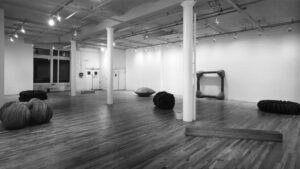
Winsor’s sculptures, constructed from rudimentary materials like wood, rope, steel, bricks, twine, and copper, are associated with the minimalist art movement of the 1960s and 1970s. Her work drew admiration from critics for its labour-intensity. Her pieces made their way into the permanent collections of the Museum of Modern Art, the Metropolitan Museum of Art, the Whitney Museum of American Art, and the Solomon R Guggenheim Museum in New York, as well as the Art Institute of Chicago, the Detroit Institute of Art, and the Walker Art Center in Minneapolis, among others.
In 1979, MoMA presented a mid-career retrospective of Winsor’s work. It was the first retrospective show of a female artist in the museum’s department of Painting and Sculpture in more than 30 years (which was of Georgia O’Keefe). The exhibition traveled to the Art Gallery of Ontario in Toronto and the Fort Worth Art Museum in Texas, cementing Winsor’s place in the canon of contemporary sculpture and opening doors for women artists who would follow.

Eagan argues that Winsor’s aesthetic came from somewhere more specific than the artistic trends of her time.
“Winsor’s sculpture is tied to Newfoundland in ways that extend well beyond her biography,” Eagan says. “Born here, and revisiting the place often throughout her life, she absorbed a visual and material language shaped by necessity, care, and resilience. Her use of wood, rope, steel, and other repurposed materials echoes the province’s long-standing traditions of making do with what’s at hand – and making well – drawing on resourcefulness and a close relationship with the land and sea.”
Winsor’s minimalist creations reflect the artistic styles of her contemporaries, but also carry traces of the Newfoundland island environment, added Eagan. “The island’s wide horizons, stark tonal contrasts, and spacious landscapes undoubtedly became part of her way of seeing. In her sculptures, those sensibilities translate into a distilled clarity – an aesthetic shaped as much by place as by practice.”
In a 1974 interview with Artforum magazine, Winsor herself articulated this connection directly, describing a romantic, nostalgic bond with her birthplace. She noted that most places diminish in scale when revisited as an adult, but Newfoundland retained its expansiveness. “New York is the only place I’ve lived since Newfoundland that has that same sense of scale and dealing with the environment,” she said.
Her connection to her childhood seeing her father build houses is expressed in pieces like Nail Piece from 1970, in which seven pine boards are stacked and adorned with nails. Michael Coyne, who was the head of the visual arts department at Memorial University’s Grenfell Campus, met Winsor in 1994, the same year she received an honorary degree from the college.
He sees the roots of Nail Piece in a childhood story. When Winsor was nine years old, her father once gave her a bucket full of bent nails and told her to straighten them out. She straightened every nail, then hammered all twelve pounds of nails into boards, a task that seemed to anticipate her future. “If you were to trace it back,” Coyne said, “you would probably trace it back to those 12 pounds of nails that she pounded in as a child.”
For Coyne, this story speaks to what made Winsor’s work so powerful and authentic. “She took these rudimentary processes that are rooted in her childhood, in Atlantic Canada, and just blew it out of the water and reached the highest pinnacles of success,” he said. “And that accounts for the authenticity of her work.” Rather than learning primarily from art books or theory, Winsor worked from an appreciation and embrace of material.
“The artist is taught by the materials,” Coyne said, a principle he used to share with his own students. “And I think she sort of exemplified that.”
This approach helped Winsor rise above the noise of the art world. “Who’s going to buy four pieces of wood strung together with twine?” Coyne asks. Yet she found representation at the prestigious Paula Cooper Gallery in New York, and her work continues to appear in exhibitions today, including recent shows at MoMA and international art fairs. Her pioneering role in Minimalist sculpture endures because, as Coyne puts it, she “cut through all of the kind of nonsense” to create work that was true to her own experience.
Dale Roberts, a Newfoundland-born artist now living in Victoria, B.C., experienced Winsor’s connection to the island firsthand. A sculptor himself, Roberts worked as Winsor’s studio assistant in New York during the 1990s, a period when he was pursuing his MFA at Purchase College. He enrolled in the program in 1992 and decided to locate New York artists he felt some connection to – either in their art or philosophy. He contacted a number of artists and worked for several, but with Winsor the bond was “immediate,” which he attributed to their shared homeland. “Interestingly when I was in my teens, I met one of her relatives while researching a branch of my own family tree with the name Winsor,” he said.
Roberts was 29 when he began working with her. “As her assistant my work ranged from assisting in the building of artworks for exhibitions, material sourcing, to helping set up archives of her work,” he said. “Together we would go to gallery and museum openings and talk about the world of art and artists.”
The initial period of working with Winsor had a profound impact on Roberts. “There were days of mostly silence and meditation. I was introduced to Siddha Yoga and met her guru at the Ashram in Fallsburg, New York. It introduced the idea of the sacred space of making art with another person and being fully present in what it takes to create art.”
Throughout their time working together, Newfoundland remained a constant presence in Winsor’s life and conversation, he said “Jackie and I talked frequently about Newfoundland,” Roberts said. “There were times when we would have [Newfoundland] suppers at her loft and invite her art friends for Jigg’s Dinner. It was sometimes a real quest to track down the ingredients, but we had fun in the adventure.”
Roberts recalls that he got to know her family quite well and even travelled to Burnt Point to spend time with her mother for her birthday, delivering gifts all wrapped in a giant Newfoundland flag. He and Winsor even worked together to create albums of family history and Newfoundland travels.
This pattern of departure and return, and of maintaining ties across distance, fits within a broader tradition in Newfoundland artistic culture. As Eagan points out, the island lacked substantial professional cultural infrastructure to support artists until the 1960s, with continued development in waves afterward. “There was no real, professional cultural infrastructure here to support artists (such as art galleries, funding bodies, schools) until the 1960s, with the infrastructure continuing to grow after that time,” she explains. “For that reason, many artists, up until somewhat recently, had to go elsewhere to study and to make a living.”
This geographic dispersal of talent hasn’t diminished Newfoundland’s cultural identity, but complicated and enriched it. “Newfoundland and Labrador artistic culture is one of continual waves of arrivals and departures,” Eagan notes. “There have been artists that have chosen to stay here, who come from away, and contribute immensely to the culture here – think of the Bulgarian artists, or the artists who came through St Michael’s. On the other hand, there are people who come here for a short time, and the place stays with them – affects their art moving forward. Think of Fogo Island Arts, or the residencies in the parks.”
Eagan also points to artists who live elsewhere but remain tied to the island through their imagery, citing painters like Takao Tanabe, John Hartman, and Michael Snow.
“The key point is that, although (Winsor) only returned here intermittently, she created art that resonated with the history and essence of this place.”
For Eagan, this is what makes Winsor’s legacy particularly significant. “Culture is a constantly shifting conversation, but this place was a touchstone for her. And, for that reason, because she felt an affinity for her home, we can claim her as part of that cultural conversation as well.”
Winsor’s personal life was as rich and complex as her artistic practice. She was married for 14 years to Keith Sonnier, a fellow artist and classmate at Rutgers University. Sonnier, born in Louisiana, is credited with being the first artist to use light in sculpture in the 1960s. In addition to her own artistic pursuits, Winsor was a dedicated teacher at the School of Visual Arts in New York, passing her knowledge and approach on to emerging generations of artists.
Winsor’s sculptures continue to be studied and admired for their rigor and thoughtful use of material. But for those who knew her, and for those who understand the pull of home across distance, her sculptures carry another meaning. They are objects made by hands that knew the textures of Newfoundland, and by a heart that never forgot where it came from.
She proved that an artist could leave home without leaving it behind.
Courtney Zwicker is a Nova Scotia–born journalist with more than a decade of experience, now based in St John’s, NL. An alumna of the University of King’s College, she began in local daily news and now writes for Canada-wide Real Estate Magazine. She has volunteered with the Anna Templeton Centre, Persistence Theatre, and Eastern Edge Gallery, and joined the National Magazine Awards jury in 2026.
Find this feature and more in Spring 2026!