

Agitator, draft dodger, journalist, dad: Alex Bill publishes a biography of his father, Roger Bill
January 2026
Congratulations on your new book, Dangerously Close to Contempt. Where did the idea come from?
I was at a point in my professional life where I wanted to push myself and expand what I thought I could do.
And I weighed several different topics and ultimately settled on one that was close to my heart that I thought was interesting, both because Roger has an interesting life story, and through him there are tendrils into dozens of other different stories.
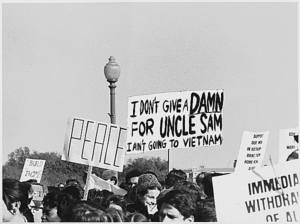
You cover decades of his life, from growing up in Muncie, Indiana, to his decision to leave for Canada to avoid the draft, through his involvement with the uproar over Atlantic Place, his work provincially and nationally with the CBC, publishing Current – there’s so much and the backgrounds – the anti-Vietnam War protests, the downtown St John’s heritage battles, the restructuring of the CBC – are so interesting.
Every time I talk to somebody who’s finished the book, they bring up something new to them – for example the Luben Boykov connection and Roger’s role in him staying in Newfoundland [after he and his family defected at Gander Airport in 1990]. So my publisher compared it to Forrest Gump that way; there’s a character involved and it’s through him that you get these glimpses into history, some of which are really unknown or underreported. I thought I was in a unique place to be able to tell that story. And after some convincing for Roger, that’s the path I pursued.
It must be a really strange way to approach a relationship with your father, writing his biography.
Yeah, it was. I think the reader probably sees that I have an affection for my father, but I hope they see that I’m also a journalist and treated him professionally as well. And I didn’t actually struggle too much with that balancing act internally. And I don’t think he did either. I think it’s because he understands what it takes to tell a story properly. My mother’s [Deanne Fleet] considerations weighed heavily, and maybe that was the trickier family dynamic. But ultimately, she’s a journalist too, so we all sort of get it. And, you know, I thought it was good for me to reflect and to talk to people about the sides that maybe are [less than] glowing, you know? And that was important to tell the story, honestly, because if it’s just talking to family, you’re only getting a shallow and narrow piece of a story. Roger’s not always right. He’s not always looking the best.
Has he read it?
Oh, yeah. And before publication, because that’s going through legal steps and that sort of thing, and he had useful feedback. He’s not an emotional guy. And I think I mentioned in the book that when it comes to events and his recollections, it’s very detailed. To ask him about he feels about things, it’s a much shorter conversation. I think he’s proud of me. I think he is ambivalent. I don’t think he cares to be in the public eye so much. And for most of his career, he wasn’t. He was behind the scenes in a lot of ways as an activist, as a journalist, and even when he wasn’t and he was in the front lines he was often on a radio. And that was earlier in his career too. So, yeah, it’s not in his nature to talk about himself. So he definitely didn’t jump at the chance for somebody else to either. But he’s always been a supportive parent, and he supported my decision to go for it. It was contingent on a publisher agreeing that it was worth it. So I talked to local publishers and found After Books and they thought there was something here.
Can you take us a little bit through your research process? I found it thorough, and the writing lively and nicely contextualized.
Thanks. At the risk of some immodesty. I sometimes use the line: a lot of people have written books about their parents; few of them have, I forget the number, 200-something footnotes or end notes. It was one of the ways I wanted to kind of touch on a personal subject, but keep it professional to thoroughly, in some cases exhaustively, research it. The third chapter, about the downtown activism, was the most time-consuming on that front.

Why was that?
Because there was a lot of available material. The Centre for Newfoundland Studies and Archives and Special Collections had a ton of material. The old newspapers, the Daily News and Telegram, on microfilm, was really useful. These were kind of public issues that he was involved in. It wasn’t about his news coverage then because he wasn’t a journalist. It was city planning stuff. And it was a lot of fun to research that. Some of the other stuff is more personal and is more interview-based, but I still found a lot of information I can research to contextualize it.
And I thought that was one of the strengths I brought to the table because that’s what I do in my day-to-day life as a business and politics journalist. The research side is where I was confident about that more than I was my writing.
Did you start with interviews? Or did you start with research?
Yeah, simultaneously. And one would often inform the other. I couldn’t tell you the number of sit-down interviews I had with Roger, but it would be around 20. And some of them are 10 minutes, and some of them are 2 and a 1/2 hours. And depending on who I talked to, it would take me back to other places to research and find information, whether that’s the foreign correspondence stuff or the kind of real estate issues on the Sussex Place side of things. It wasn’t one or the other, they were hand in hand and flowing back and forth.
So when you wrote it, how did that unfold – did you just go chronologically?
I did. For a couple of reasons. It just felt a little easier to organize in my head that way. An element of this is that some of the people whose input would have been really valuable aren’t here anymore. And that includes Gloria, I forget her last name, who was the person who kind of helped him get set up in Halifax and influenced him to come to Newfoundland in the first place. And that certainly includes Chris Brooks [with whom Roger had an intinitially productive, but later highly contentious, professional association]. And by doing it chronologically, because it was a two-year process start-to-finish, there was a risk of other people not being there. And then it was later in the process that I had the idea to frame each chapter by taking a piece out of that chronological context and putting it at the front as a scene setter – almost as a way of kind of upsetting that chronological flow. And the chapter I struggled with the most was the last one and it was my publisher who had the idea to also take the ending and bring it back to that very early scene. I was grateful for that because that was the hardest piece.
Why was that the hardest?
Because I’m involved. I’m an adult. We’re touching more on family stuff, my siblings, our relationship. There’s some people I talked to who thought the book should have been more of that. And I didn’t want that, but I think our relationship with him as his family is a part of his story. There are a lot more people involved, it’s all contemporary, feelings can get hurt more easily. And I think ending a book is hard.
I’m surprised that you’re saying it only took you two years.
A couple people have told me that. I put a lot of time into it. I had to organize myself because I have a day job [with allnewfoundlandlabrador.com] that is pretty intense, time intensive, and it often takes me into evenings. I set aside weekends, evenings. I took some vacation time to dedicate to the book, especially in the final thrust to get my final draft. But in February of 2025, I finished the draft of each chapter. And I took a week’s vacation to really block out everything and do like 10 hour days for 6 days. I tend to be somebody who has a hard time setting aside 20 minutes a day to do something, I set aside 8 hours to do something. It’s just how I’m wired. Once it got going, I was passionate about it and I found the time wherever I could.
Did you discover anything unexpected or disturbing?
Not a lot. Because a lot of these stories I had sort of known before. There were details and nuance, things that I was expecting, and some things I was expecting to happen didn’t. Like the Brooks situation. I was waiting for the final act to have this dramatic conflict and it didn’t happen. It was little, tiny pieces and slights or perceived slights over years that drove two people apart. Not one big thing. But I was happily surprised how easy it was to tie a narrative theme together. It’s nonfiction and biography. You can’t always do that. Your life happens in stages and sometimes they’re not so connected, but from early life to today, there is this agitator, this restlessness, that still exists, this damn-the-torpedoes type thing. And that was from when Roger was 10 years old to 80 years old. And I wasn’t sure that was going to happen. As the writing progressed, I realized that that was easier than I thought.
In terms of people being upset, like, your dad certainly says some stuff about Ron Crocker, who was the CBC executive who oversaw the merger of NL and Maritime television departments, among other decisions. But the way Ron Crocker responds, you allow him to be kind of gracious.
Ron and Chris probably get it the worst. And I did my best to let Chris posthumously have his say. I went to his widow. I went to his book [A Public Nuisance]. I did try and see the other side and talk to people like Ron and others who might have butted heads with Roger. I reached out to Kevin Breen [about the 2005 RNC investigation into his defaced city election campaign signs and the subsequent trial] but didn’t hear back.
Can Greg get in trouble?*
No, the statute of limitations is passed.
Dangerously Close to Contempt: The Restless Life of Roger Bill. Journalism’s Unrepentant Agitator, is available at local and national bookstore – and soon Bill hopes in the US – and After Books Is regularly set up at the SJFM Book Fairs.
*Read the book.