

A History of Her Majesty’s Penitentiary: David Harvey takes readers Inside the Walls
January 2026
Can you talk about the format of this history – it’s almost a scrapbook of news articles, training manuals, personal documents. How did you organize and contextualize all this?
This whole idea started not as a book but as a pamphlet I was planning to hand out to staff about the history of HMP. I was thinking about it for a while and around 2007 I started collecting bits and pieces of the history of HMP. I soon realized that there was a lot of information out there about HMP. I wanted staff to know a little about the place they were working and some of the past history. It was around that time that I thought that a book would do more justice.
I started out researching at the Provincial Archives, MUN library, and the AC Hunter library. After a while I realized that the bulk of information I was looking for was right under my feet, in the basement of the prison. There were documents there dating back to 1838 tucked away in old boxes and ledgers. So, I started digging. I would spend many lunch hours and days off in the basement going through boxes of documents picking out interesting items that I thought others may find interesting. I found reports, pictures and letters from days gone by that made for very interesting reading.
Now the real work started. I had no idea on how to put this together into a readable book. I figured I would start from the earliest papers and work to the present day. This did not happen overnight. Between work and home life there was not a lot of free time. I would spend weekends at my cabin where I found I could get the most work done.
Finally, by 2013 I had what I thought was a readable manuscript. I had to find a publisher but I also had to have the manuscript finalized by the Dept of Justice. As you can imagine this was not a priority for officials in the dept. Eventually after a few changes suggested by the dept’s lawyer the book was ready to go. Now to find a publisher. I went to a couple of publishers and they wanted what I called “dirt” on HMP. This was not going to happen. My goal was to write about the history of HMP. Finally, I found a publisher that accepted the book as it was, word for word. The book was on the shelves in late 2014. I had retired in July of that year with the rank of Captain.
You introduce us to many characters – Wo Fen Game, Alexander Pindikowski, Otto Kelland (who surely deserves his own biography) – did any life story you came across really surprise or upset you?
As you can imagine, working in a prison you came across many instances that at times shook you to the core. I witnessed attempted suicides, completed suicides, violent assaults by inmates on inmates, riots and so on. Prisons can be very violent places.
Your brief history of penal punishment – how few years we really are from torture as the official punishment for crime – was startling. What lessons about punishment and incarceration should readers take from this book? What should we hope for from a new penitentiary?
Years ago, prisons were meant solely for punishment. Up until the early 1940’s children as young as fourteen or fifteen were sent to HMP and received corporal punishment for petty crimes. Their punishment would commonly be a number of lashes of the birch rod upon their arrival and a number of lashes upon release. Thankfully these days are long gone.
HMP was never built to accommodate rehabilitation. The old centre block was opened in 1858 and believe it or not prisoners housed in the old centre block used honey buckets right up until the early 1980s. That meant they were paraded every morning outside to empty the buckets into a hopper. In the mid-1940s two wings were added that had cells with toilets and running water. In the early 1980s a new addition was added where inmates had their own cells. This didn’t last too long because of overcrowding.
These conditions were not conducive for rehabilitation. When I retired from HMP in 2014 there were several classification officers, addiction councilors, and a psychologist on staff. These people had my utmost respect for the work they were doing and the physical conditions they had to put up with.
With that being said I believe that we will always need prisons to hold what I call the “bad ones”. No amount of rehabilitation will help some of these repeat or violent offenders.
With the ground broke for a new prison I understand there will be great strides towards rehabilitation. All I can say is …. about time. The first documented request for a new prison that I found dated back to 1966 when then Superintendent John Fagan suggested that a new prison be constructed on Red Cliff just on the outskirts of the city. Since then, consecutive governments have attempted to start something but failed miserably.
When the new $700 million prison opens in 2029 it will house up to 300 inmates. This includes female inmates. The focus will be on treatment and rehabilitation. The new design will encourage staff and inmate interaction in a safe, secure, and humane manner.
You’ve written about the penitentiary because you worked there – but you say you have an interest in history; do you have another project in mind?
I do have a very keen interest in local history. I have a large collection of books on the history of Newfoundland and Labrador. It’s amazing how many books have been written over the years documenting events that have occurred. I have been thinking lately of putting something together in the historical fiction genre about HMP. Right now, it’s just a thought but who knows.
Another project I started about twelve years ago was a museum/archive at HMP. I had quite a collection of artifacts and documents but nowhere to display them. With the help of then superintendent Graham Rogerson, we managed to convert a small space in the basement of the HMP administration building into an area where I could display artifacts and documents. Display cabinets were built by inmates in the prison woodworking shop under the supervision of the carpenter shop officer, and what a fine job they did. This museum was not open to the public but upon request I would take anyone on a personal tour. Unfortunately, over the years this space was converted into offices. A lot of the artifacts and documents were boxed up and put into storage. I have requested space in the new prison to display and store the documents and artifacts I have.
During my research of HMP I came across many old documents and legers. These were stored in the basement of HMP where it was cold and damp. I realized that if these documents stayed there, they would eventually rot away. I first contacted Larry Dohey at the rooms and he agreed to come over and have a look. He agreed with me that the documents should be removed and stored in a proper storage area. This took time and several meetings with officials from The Rooms and government. Finally, around 2017 permission was given to remove the documents to The Rooms where they would be properly restored and stored.
In 2018 with the help of Dr Madeline Mant and Dr Megan Burchell of the MUN Archeology Department, a display of HMP artifacts were put on display in The Great Hall at Queen’s College at MUN. The name of the display is “TIME ON THEIR HANDS” This is a collection of artifacts from HMP from the early years to present day. This exhibit is open to the public and can be accessed for free in Queen’s college, Monday to Friday 9-4. I also have a facebook page with plenty of information on HMP. This can be accessed by typing in “HMP Museum/Archives.
Is there anything I haven’t asked you that you’d like to discuss?
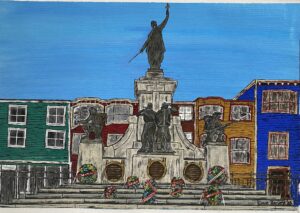
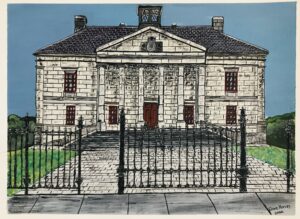
About five years ago I picked up painting. I walk almost every day in the older downtown parts of the city. I enjoy taking in the architecture of the older buildings and homes in the area so I started to paint them. In retirement you have to keep your mind and body occupied.
Inside the Walls (DRC Publishing, $19.95, 272 pages)