

When you get to the ice there is much excitement: Cecil Mouland, last living survivor of the 1914 seal hunt disaster
March 2026
NQ’s Summer 1980 issue (vol LXXVI, no 2: Price $1.00) included The ‘Newfoundland’ Disaster of 1914: An Interview with Cecil Mouland, a Survivor, by Lieut Calvin Collins. Here’s an excerpt:
Introduction
On a black midnight, March 9, 1914, the SS Newfoundland left St John’s harbour heading for the ice-fields beyond, with its crew including some sixteen year old lads who had their ‘berths to the ice’, and fifteen year old stowaways. Among them was one Mr Cecil Mouland.
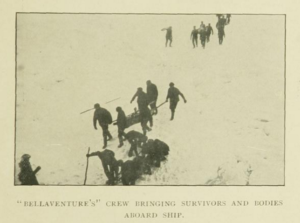
Each year for generations, poor, ill-clad Newfoundland fishermen sailed ‘out to the ice’ to hunt seals to make a living. The year 1914 witnessed the worst in a long line of tragedies that \vere part of their harsh way of life. For two long freezing days and nights there were one hundred thirty-two sealers who were stranded on the Arctic ice. They \were thinly dressed, with almost no food and with little hope and shelter. The snow and constant winds were bitter. They had to keep moving to survive; always moving. Those who laydown to rest died. By the time help came, almost two-thirds of the men were dead.
In this paper I shall attempt to recap this thrilling, but sad story, as told to me by one of the survivors from this sealing disaster – Mr Cecil Mouland, who is now eighty-three years of age, as he recalls this portion of his life history. Mr Mouland is a man of wit and humour, which I have tried to portray in this paper. Some of the expressions used may not be ‘standard English’, but this will serve to make the paper and story more interesting. I will endeavour to make the story ‘come alive’. In places it will be serious, while in other places it will be humorous, as Mr Mouland relates it to me.
A Biographical Note
Mr Cecil Mouland was born in1893 at a place on “The Straight Shore’ called Doting Cove, Fogo District. Mr Mouland relates that the name of the place is so called because when the earlier settlers who came from Bonavista settled there, there were lots of seals and these seals were called ‘doters’ and this name emerged as the name of the community.
Mr Mouland lived at Doting Cove until 1923 after which he went to the United States to live. He received his formal education at Doting Cove, advancing as far as the “fourth reader”. When people in the United States asked him if he went to high school, Mr Mouland replied, “I sure did, I attended a two-storey school, and my classroom was on the second floor. It was high all right!”
In 1912 Mr Mouland went to the “ice” and two years later, in 1914, he went again. This was his last trip to the ice. He became interested in the seal industry because it \vas the usual thing to do at that time he said; everyone was involved in this type of livelihood. His father \vent to the ice every Spring fortwenty-eight successive years – this probably influenced his decision as weil.
When you get to the ice …
There is much excitement, says Mr Mouland, when you arrive at the ice floes, wondering if you will get in to a good herd of seals, and how many seals each crew member will ‘pan’. There wasn’t much to do while waiting to ‘go over the side’, onto the ice, most men just lay in bunks, each person took their turn on watch duty while on board ship.
The ships at this time were run by engines operated by coal as fuel. The men would line up in an assembly line and pass along buckets of coal to the person who was in charge to keep the engines running. No one went onto the ice until there were seals, then it was only on the orders of the Captain, who in this case was Mr Wes Kean from Wesleyville.
You can read the full article here, and find issues of NQ right back to 1901 here.
This is the first in an occasional series of special selections from the NQ Archives, marking the magazine’s 125th birthday in 2026.