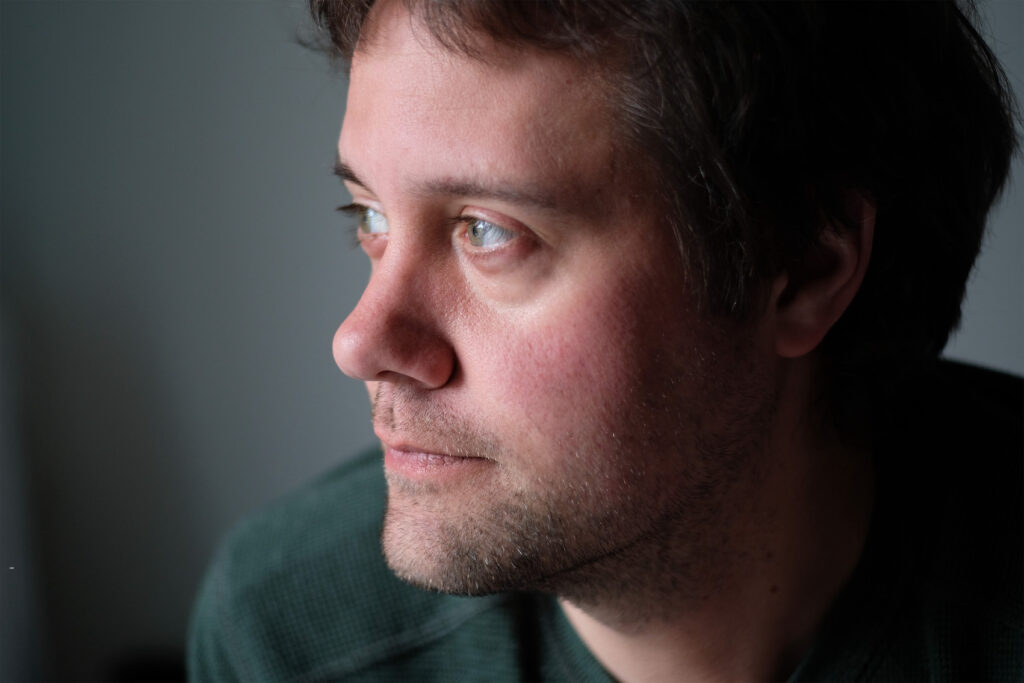


Art making is how I understand the world: Reed Weir
February 2026
Can you tell us a little about yourself and your art practice?
I am a multidisciplinary visual artist. I sometimes describe myself as a “serial material monogamist,” meaning that I work intensively, often exclusively, in one medium for extended periods of time. While living in Newfoundland & Labrador, I worked almost exclusively as a ceramic sculptor. Since returning to Ontario, I have translated many of the concerns I developed in clay into two-dimensional painting. The shift in medium has not altered my core interests; rather, it has expanded how I approach surface, structure, and gesture. What I developed in ceramics continues to inform my work in paint.
I believe I was born an artist. Making is inseparable from whom I am; it is how I think and come to understand the world. When grounded in the studio, I work daily.
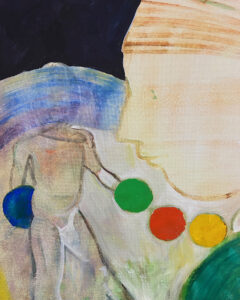
My practice engages tactile surface, composition, colour, and the relationships between people and their environment. I am particularly drawn to the human capacity for abstract thought, our ability to move between lived experience, internal reflection, culture, and environment. This ongoing tension between the physical and the conceptual continues to shape and guide my work.
Congratulations on your new publication, watersmeet – how did that come about?
My move to McKellar, Ontario, began a search to understand the community I had entered. In looking for a visual language reflective of the region, I found myself working in the shared space between the natural environment and human habitation.
While developing imagery rooted in McKellar, I reconnected with Mori McCrae, a former classmate from the Ontario College of Art and Design. When she read her poem Shelf Life, I recognized a parallel in our thinking, two artists, on separate paths, arriving at similar concerns. I asked if I might use her poem as the underpinning for a new body of work. She generously agreed.
I set clear parameters: forty-five canvases completed within a defined period. Each day I read the poem before painting, not to illustrate it, but to absorb its cadence and allow it to quietly inform the work.
This inquiry became watersmeet, the series and the book.
Which artists, not necessarily visual, most influence and inspire you?
My visual influences are fluid. I have affinities for too many artists and styles to claim just one. But I do have a touchstone.
I am, unabashedly, a devoted reader of Vladimir Nabokov. I return to him regularly and, looking back over the past twenty years, I realize I have read at least two of his books each year. Some I have revisited multiple times, Pale Fire, for instance, at least four. Each reading reveals new layers. I am drawn to his playfulness with language, his humour, and his acute understanding of human vulnerability and culture. His writing is intricately structured, yet it feels fluid and effortless. At times I open one of his books at random and read a single sentence, just to enjoy the flow. I admire many writers, but Nabokov is the one I return to, like an old friend who never becomes uninteresting.
The irony, of course, is that he was not particularly invested in visual art or music, two elemental forces in my own life.
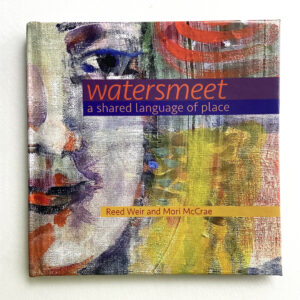
watersmeet / a shared language of place: Reed Weir paintings, poem by Mori McCrae is available from www.reedweir.com; a first printing has sold out and Weir is taking orders for a second. The exhibition was featured at Jonathan Bancroft-Snell Gallery, London, ON (October 16 – November 8, 2025).
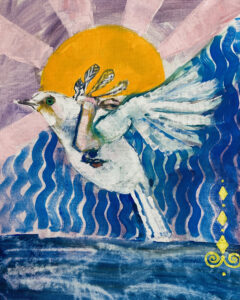
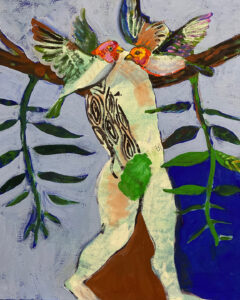
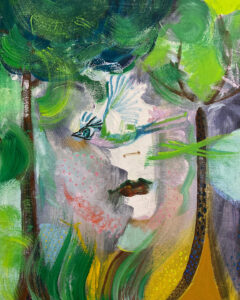
(Images: Shadow Of A Bird, Necklace, Water Portrait, Forest Walking, watersmeet cover, Forest, courtesy the artist.