

50 Years In the Building: Part 2 of our conversation with Don Mikel
December 2025
You’ve talked about Streamline Moderne. It seems like something comes into fashion, everybody wants it, and then it goes out of fashion – like poured concrete buildings were once a sign of the future, and now people want them gone. What do we lose when we lose buildings?
Well, you know, we lose a lot of things when we lose buildings. I’m wondering if you’re referring to Brutalism, because it was a poured concrete style in the 1970s. And a lot of buildings were built like that. And now there’s mixed feelings about them. But what happens when we lose buildings and what the purpose of heritage conservation is, is so that communities, which are – now, let me see if I can express this properly. If you grow up in a stable community, it’s an environment, and it’s a touchstone for people, and you want to have communities that don’t stand still. I mean, we don’t want every neighbourhood to be a museum. But what we do want is for houses, for neighbourhoods and main streets, to evolve sympathetically. So that they retain their character and retain the touchstones that are important to people, because there’s nothing worse than returning to the house you grew up in, to find out that it’s been ripped down and something else put in. And we’re going through a period now of population pressures. We’re back to this development versus preservation. And it’s not a case of versus. It’s a case of we can have both, if we do it properly, through planning and zoning, which a lot of communities aren’t. And so we’re sacrificing art forms, cultural expressions of our communities. Just to build new houses. But you can manage it so that we can do both.
You talk about Churchill Park in the book. And, of course, that was the first such community in what is now Canada. And a lot of people now buy the houses that are there, tear them down, and put up a much bigger house, which completely throws off the footprint of the area.
I agree, because I drove through that area. Not only were they being pulled down, but they were being altered in unsympathetic ways, and I had trouble finding – I mean, I have two or three examples from that area in the book – but it was, it was hard, difficult, to find untouched examples.
Is there such a thing as a truly ugly building?
[laughs] Well, I think probably, but then, you know, beauty is in the eye of beholder. And if you go back to Brutalism, for example, in Toronto, there’s the Robarts Library, which is considered one of the finest examples of Brutalist architecture in North America. But at the same time, many people think it’s a giant, ugly carbuncle in the middle of the University of Toronto. So it’s all a matter of perspective, and also it takes time. Fashions go out of style. As the Victorian era went out of style at the turn of the century, I’m sure people looked at Victorian Picturesque buildings and thought, Oh, old, fussy, don’t like it. But now, given 120 years or whatever, people love them again. So it’s hard to answer that question. Is there an ugly building? I mean, what would be ugly is taking a building that is a good example of something, and then altering the appearance so thoroughly that it’s no longer attractive or recognizable.
Your book is also really user-friendly. You include checklists of for different styles. And I noticed when I was looking through it, I was looking at the pictures and going, Oh, if only there was a way to learn which ones are from St John’s and Newfoundland. Of course, you’ve got that organized at the back. You’ve got it indexed geographically.
Actually, that was [the publisher] Lorimer’s idea. I learned a lot from doing this book about how to organize it, but my intention from the beginning was to create a guide that was clear and concise, and would help people be able to quickly learn about buildings in their environment, or when they travelled. And part of that purpose was to help people get a greater appreciation for heritage conservation, because when you think about it, we go to art galleries to see paintings, but we, in fact, have a lot of great art around us in our architecture. And so, if you approach a street thinking, Oh, I’m going to see interesting things, and if you find that you know about these things, you’ll have a greater appreciation for what our built culture is.
You also acknowledge in the book that there’s a whole Indigenous architecture and style that you don’t have the background to deal with. Is anybody working on anything like that right now?
Probably. But I don’t know who. And one of the problems with that, too, is that most of it has disappeared. And a lot of it was temporary, the architecture of nomadic people. There are reconstructions, in Ontario, there are a number of reconstructed villages and things like that. And I don’t know about Newfoundland, but you have the reconstructed Viking [settlement], and that sort of thing. So we have reconstructions, but it’s really a whole field that is not my expertise, and I don’t want to presume to explain this culture or architecture, but I do want to recognize that it existed for, I think, about 12,000 years before we got here.
Is there something that I haven’t asked you about the book that you’d like to discuss?
I haven’t really talked too much about some of the great examples. Each of the chapters starts with a landmark example.
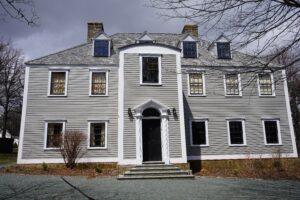
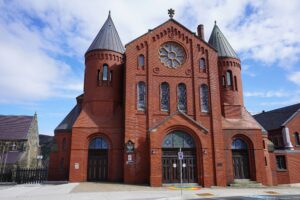
And so for the Regency, we have the Hawthorne cottage in Brigus, which is a really early and important example of a Regency house. Built in 1830. It has the lovely verandas and the picturesque setting. And then for the Classical Revival, I used the Colonial Building, built by James Purcell in 1850. And that Colonial Building is one of the most stunning examples of Greek Revival in Canada. And then there’s a really beautiful atmospheric church, and it’s the landmark example for the Romanesque, and that’s the Gower Street United. And it’s a great example, but you have many, many really important buildings. I mean, there’s the Commissariat House, 1818 to 1820.
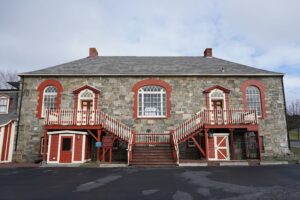
The Alexander Hewson, a Hugh Emerson house. The Courthouse in Harbour Grace, it’s a stunning example of Regency Style. And lots of other iconic buildings like the Cape Spear Lighthouse, Victoria Hall, a good example of an Edwardian building. And then both your cathedrals are important examples designed by important architects. And the Catholic cathedral, St John the Baptist Basilica, it’s really interesting because it’s built in the Norman Revival Style, which was usually reserved for secular buildings or buildings that were neither Catholic or Anglican, but the most important Norman Revival Style building in Canada is that Basilica, and it’s a Roman Catholic church. And so that makes it a distinctive and important example. And the Anglican Cathedral, I think also called St John the Baptist, is by an important British architect, Sir Giles Gilbert Scott, and so some really fantastic things there. You’ve got a really interesting synagogue, the Beth El Synagogue, 1961. It’s a mid-century Modern Contemporary Style synagogue, and it’s round, and that’s very interesting. And then the presence of the jellybean houses throughout the city makes it very colourful, interesting, and distinct. So there is a great deal, and then there’s all sorts of things that I didn’t put in the book because, you know, if I could put everything that I wanted to in the book, it would be 75,000 images. But I picked out the things that I thought were most representative are most important.
Do you have plans to visit NL again soon?
I don’t know about soon, but I definitely want to go back and tour around. And you know what was interesting? There is a really, really good house in Corner Brook called the George W Smith house. He was an architect and he designed it himself. It’s Streamline Moderne, and if I’m not mistaken, I used it as the example for Streamline Moderne. Anyway, I flew [to Deer Lake], and a friend of mine was supposed to pick me up and take me to Corner Brook, but I got a message that morning to say they had COVID. So I ended up making my own way there in a taxi. And the weather wasn’t very good. So I stood in front of that house for four hours. Waiting for the weather to change so I could get a good picture. And I chatted with the family as they went in and out, and, you know, they were curious as to why I was there. But I finally did get good shots of that house. And then I went to the [Glynmill] Inn for lunch and then I flew back to St John’s. But I thought it was worth the trip. There’s one next door also designed by Smith in the same style. But I didn’t get to see too much of Corner Brook. So, I’d like to do a complete tour of Newfoundland, because there are many important communities; I didn’t see Trinity and that sort of thing.

Canadian Architectural Styles: A Field Guide is published by Lorimer.
(Images: The Colonial Building, Commissariat House, Gower Street United Church, Harbour Grace Courthouse, courtesy the author; author’s photo courtesy Lorimer.)